Életmód
European Birdwatching Days 2026: how to join
On 3 and 4 October, birds will once again be counted across Europe. You do not need to be an expert to take part: garden observations can also be submitted until 4pm on Sunday, and free events are available around the country.
2026-10-03 · 5 min read

On the first weekend of October, birds will once again be counted across Europe, and anyone can take part, even from their own garden or balcony. According to the Hungarian Ornithological and Nature Conservation Society (MME), the 34th European Birdwatching Days will be held on 3 and 4 October 2026. Below, we summarise how to join, what needs to be submitted, where organised events are being held, and what anyone can do for garden birds in autumn.
What are the European Birdwatching Days about?
The European Birdwatching Days are an annual programme linked to BirdLife International, the international bird conservation network. In Hungary, it is coordinated by the MME. The event is both a shared community experience and a form of data collection: participants observe and count birds on the same weekend, and the submitted data is compiled into national and international summaries.
Initiatives like this are known as citizen science. According to National Geographic Hungary's analysis, public participation is valuable in bird conservation data collection because observations made by many people at the same time provide geographical coverage that specialists alone could not ensure.
What did last year's results show?
According to a Sokszínű Vidék report, at the 2025 event more than 2.8 million birds were counted at 834 locations in 29 countries. Based on the outlet's coverage, Hungary finished first in two categories and fifth overall.
These results clearly show that participation from Hungary is significant even by international comparison. However, every single submitted observation contributes to the final result, including counts carried out in gardens.
Do you need birdwatching knowledge? Not necessarily
Perhaps the most important thing to know is that taking part does not require professional species knowledge. According to the MME notice and Sokszínű Vidék's summary, to submit an observation it is enough to provide the following:
- the location of the observation;
- the number of participants;
- the total number of birds observed;
- if possible, the three most common species.
In other words, even someone who can only confidently recognise a few common species can still submit their observation. If a bird cannot be identified, it can still be included in the total count; listing species names is an additional element, not a strict requirement.
The deadline: 4pm on Sunday
According to the MME, data from garden and individual observations can be submitted until 4:00pm on Sunday, 4 October 2026. This point is especially important because organisers use the data received by the deadline to compile Hungary's results for the international summary, so observations arriving later cannot be included.
There are two ways to submit data: the MME's online submission platform and the mobile app called TURDUS. Anyone making observations several times over the weekend should plan ahead for the Sunday afternoon deadline so there is also time to compile their notes.
How to prepare for a garden count
No special equipment is needed for garden observations, but a few simple steps can make the results more accurate. The following tips are general practical suggestions, not mandatory parts of the call:
- Choose a quiet time. In many places, birds are most active in the morning.
- Take notes as you go. A sheet of paper and a pen, or the notes app on your phone, is enough to keep the numbers from getting mixed up.
- Avoid double counting. If the same bird flies back several times, do not count it again; for flocks, the highest number seen at one time is the more reliable figure.
- Involve the family. You need to give the number of participants anyway, and for children it is a good opportunity to get to know birds better.
- If you have them, use binoculars or an identification guide. It is not essential, but it can help when naming the three most common species.
Organised events at 59 locations
Anyone who would like to watch birds in the company of experts does not need to travel far either. According to the MME, in Hungary there will be free events, guided walks and bird ringing for visitors at a total of 59 locations across 19 counties and Budapest.
National parks are also taking part. According to the Danube-Drava National Park Directorate programme notice, at Lake Földvári in Dávod there will be a guided birdwatching session on the morning of 3 October, where bird migration will also be demonstrated in practice. According to the Kiskunság National Park Directorate's programme guide, guided tours and bird ringing will be available in the Kiskunság.
The event is also present beyond Hungary's borders. The Arcus Environmental Association is organising programmes in Vojvodina focusing on the autumn birdlife of wetland habitats. Before setting out, it is worth checking the individual organisers' websites for exact locations and times.
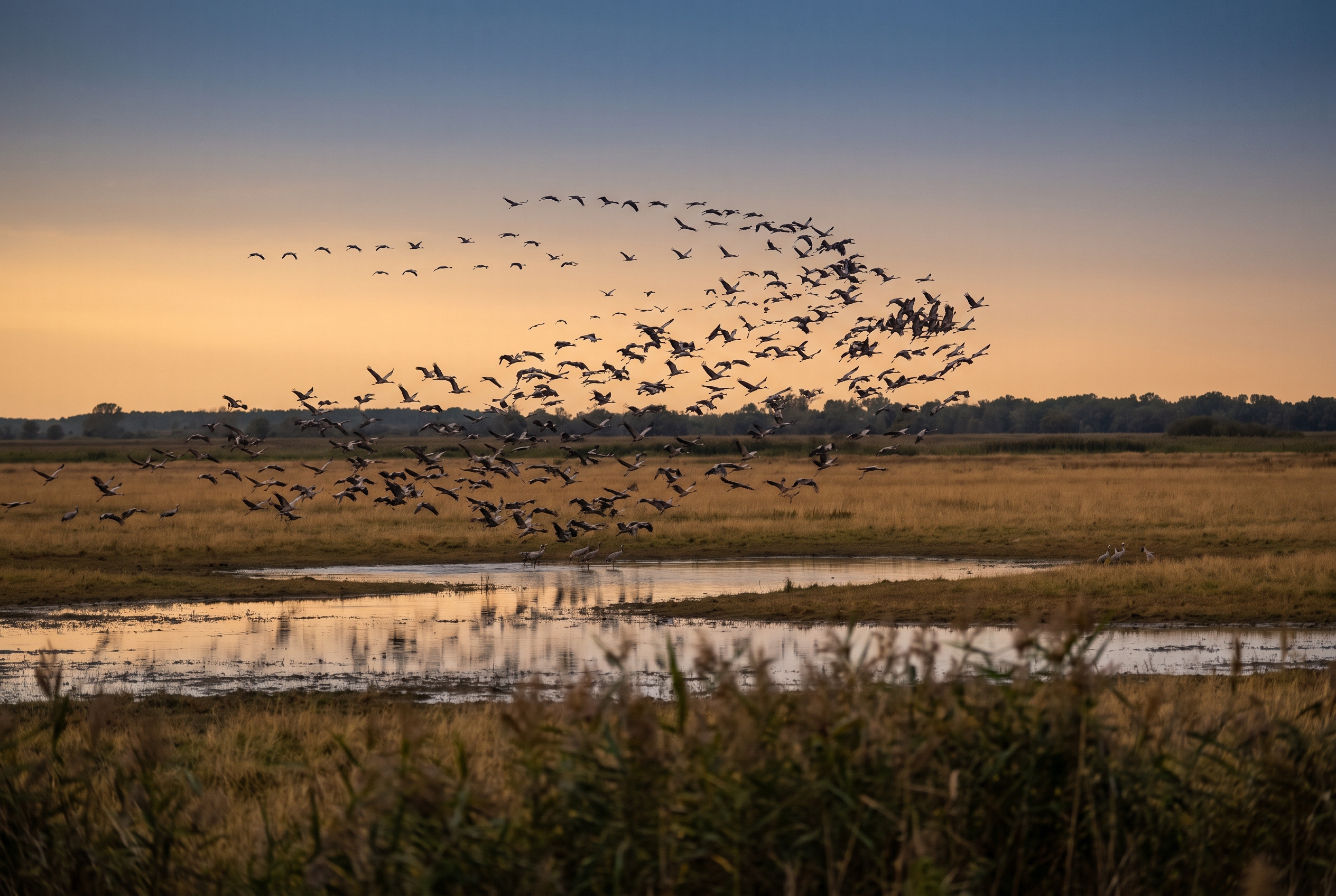
Anyone also drawn by the sight of autumn migration should read when and how to see cranes in Hortobágy.
What can you do for garden birds in autumn?
Bird counting is also a good opportunity to think about how bird-friendly your own garden is. A few general steps can help a great deal: dense shrubs and some of the fallen leaves can provide shelter and food, while clean drinking water that is changed regularly can be useful for birds at any time of year.
It is worth being restrained when it comes to feeding. Regular winter bird feeding is generally started when persistently cold and frosty weather sets in, and for detailed, professional guidance it is worth checking the MME's information on bird-friendly gardens. Anyone also concerned with garden tasks because of changing weather conditions can find more tips in our article on preparing for a sharp autumn cool-down.
In brief: how can you join?
The European Birdwatching Days will take place on 3 and 4 October 2026. Anyone can take part from home or at one of the 59 organised locations in Hungary; to submit data, it is enough to provide the location, the number of participants, the total number of birds and, if possible, the three most common species. Data can be submitted until 4pm on Sunday via the MME's online platform or in the TURDUS app. A quiet morning in the garden can therefore be not only a chance to relax, but also data that supports bird conservation work in Hungary.
Sources used
- 1.Európai Madármegfigyelő Napok 2026-ban ismme.huverified
- 2.Programjaink az Európai Madármegfigyelő Napok alkalmából 2026knp.huverified
- 3.Európai Madármegfigyelő Nap a Dávodi Földvári-tónálddnp.huverified
- 4.Európai Madármegfigyelő Napok 2026arcus.org.rsverified
- 5.Európai Madármegfigyelő Napok 2026: Országos programajánlósokszinuvidek.24.huverified
- 6.Európai Madármegfigyelő Napok 2026ng.24.hu
These sources were used during our editorial fact check.