
Praktikus mindennapok és háztartás
Winter ventilation: tackling condensation and mould
Rather than leaving a window tilted open for long periods, try short bursts of intensive ventilation. Here is how to establish a manageable routine and what to consider before spending money on a dehumidifier.
2026-11-21 · 5 min read
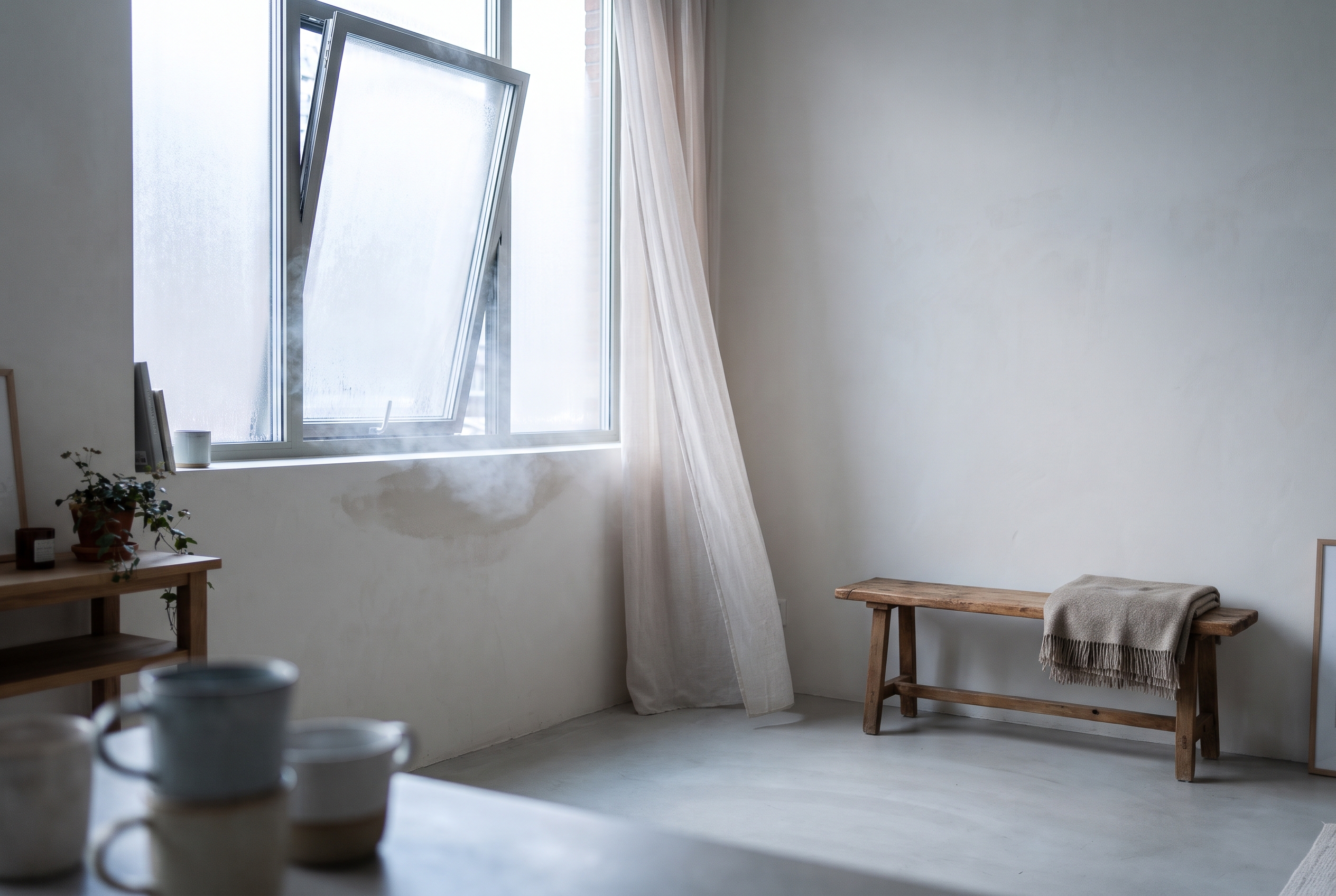
Leaving a window tilted open for long periods in winter can cool the surrounding wall surfaces, potentially encouraging condensation, warns Internorm’s ventilation guide. If your response to wet windows is more of the same ventilation, it is worth changing your approach instead. Briefly airing your home and investigating the cause of recurring dampness may together offer a workable solution.
A good window is not necessarily to blame
According to an article on ventilation in the trade journal Faipar, more airtight windows and doors require separate provision for adequate air exchange. A well-sealed window does not mean you made the wrong choice; it means that replacing your windows should not be the end of your thinking about ventilation.
Rather than looking for another product straight away, start by observing what happens in your home. When does water appear on the glass? In which room does dampness return, and does anything change after airing? These observations provide a more useful starting point than a general feeling that the air indoors is too humid.
Fog outside does not mean opening windows is pointless
As Ingatlanmérnök explains, cold winter air may contain little water vapour even when its relative humidity is high. When this air enters your home and warms up, its relative humidity may fall. Foggy or damp-looking weather is therefore not, on its own, a good reason to skip airing your home.
Two concepts help explain the difference. Absolute humidity describes the amount of water vapour in the air, while relative humidity indicates how close the air is to saturation at a given temperature. GazdaÜzlet’s explanation of these terms also describes this temperature-dependent relationship.
The practical conclusion is straightforward: do not decide solely on how the weather looks outside. Instead, observe how indoor conditions change after you close the windows and the room warms up again. This lets you assess the results of airing rather than the fog outside.
Try a brief cross-draught instead of leaving windows tilted open
In winter, Internorm’s guide recommends intensive cross-ventilation 3–5 times a day, for 3–5 minutes each time, with the heating switched off while airing. The manufacturer recommends this short, intensive exchange of air rather than leaving windows tilted open for long periods, as the area around an open window can become excessively cold.
Treat this as a starting routine, not a fixed timing rule for every home. Protektor Festék’s guidance, for example, recommends airing for 5–10 minutes several times a day. What the two recommendations share is opening windows properly for a short time, rather than leaving them slightly open for hours.
- If your home’s layout allows it, try to create a cross-draught: you can do this by briefly opening windows some distance apart.
- Follow the instructions for your own heating system: Internorm recommends switching the heating off while airing; this is not the same as allowing the whole home to remain cold.
- After closing the windows, return to your usual heating settings, then observe what happens to the condensation.
Measurements can help, but do not chase a single percentage
If you use a humidity meter, it is worth recording the temperature too and comparing readings taken under similar conditions. As Levegő GURU explains, understanding condensation also requires taking the dew point and cold surfaces into account. A single room humidity reading is therefore no substitute for observing the surface that is becoming damp.
Guidance from the Tarján IV Housing and Garage Maintenance Cooperative cites a relative humidity of 40–65 per cent as a comfort range. Do not treat this as a guarantee that a wall corner cannot become damp. A comfortable humidity range and the condition of a particular cold surface are separate matters.
Keeping an observation diary is more useful than considering the problem solved after one favourable reading. Record when you aired the room, what the meter showed afterwards and whether water returned to the same spot. This will also make it easier to explain exactly what you are experiencing to a professional.
Choose moisture-control products by results, not promises
Considering a salt-based moisture absorber or an electric dehumidifier? Before buying, clarify which room you want to use it in and which recurring problem you are trying to solve. Do not choose solely on the basis of an “anti-mould” label, or assume that buying a product automatically removes the underlying cause.
For an electric appliance, check the manufacturer’s stated operating conditions, recommended room size, energy consumption and maintenance requirements. For a passive moisture absorber, consider the replacement requirements and costs as well. Do not choose between the two types on the assumption that they are equivalent; start with the documentation for the specific product.
If you already use one of these devices, ask yourself the same question as you would about airing: has the original problem improved? As well as checking the liquid collected in the tank, look at whether the condensation or damp patch returns. You can make a cost-effective decision by weighing the expense against the results you actually observe.
An automatic air inlet is more than just another window fitting
According to the Tarján IV guidance, some humidity-controlled air inlets use a bundle of polyamide strips that respond to changes in moisture. The description explains that changes in humidity influence how these models open. This is an option worth exploring if regular manual airing is difficult to fit into your daily routine.
However, do not approach choosing one as a standalone DIY solution. The Faipar article highlights the need for building ventilation systems alongside more airtight windows, so the issue extends beyond a single component. It is worth discussing with a professional how an air inlet would fit into your home’s overall ventilation.
If a damp patch keeps returning, investigate the cause
Levegő GURU’s guidance also emphasises the importance of measurement and addressing thermal bridges. If dampness keeps reappearing in the same place, consider seeking help from a building physics or building services specialist alongside changing your airing routine. Repeatedly trying new products should not replace investigating the condition of the surface.
According to guidance from Hungary’s National Centre for Public Health and Pharmacy, high indoor humidity and surface moisture encourage mould growth. Persistent dampness is therefore worth taking seriously, but do not try to draw conclusions about health from the appearance of a patch. This guide provides general household information, not a site-specific technical assessment or medical opinion.
Start by observing the problem and trying short bursts of intensive ventilation, then check the results. It is worth spending money on a dehumidifier or ventilation equipment once you are clear about the problem you want it to solve. If dampness returns, the next step should be a targeted investigation of the cause, rather than another general household tip.
Sources used
- 1.Tájékoztató a beltéri penészedés egészséghatásairólnnk.gov.huverified
- 2.A helyes szellőztetésfaipar.huverified
- 3.Megfelelő szellőztetés a fűtési szezonbaninternorm.comverified
- 4.Penész I. - Az okokingatlanmernok.huverified
- 5.A szellőzés, lakás szellőztetés elméletetarjan4.huverified
- 6.Helyes szellőztetés a penész elkerülése érdekébenprotektor-festek.huverified
- 7.Harmatpont és relatív páratartalom - a páramentesítés fizikájalevegoguru.hu
These sources were used during our editorial fact check.