
Tudomány
Voyager–1 reaches one light-day from Earth, NASA says
According to NASA/JPL, Voyager–1 is now nearly 26 billion kilometres from Earth. Alongside this distance milestone, the mission is also facing a data transmission fault: receiving a radio signal is not the same as receiving scientific data.
2026-11-25 · 4 min read
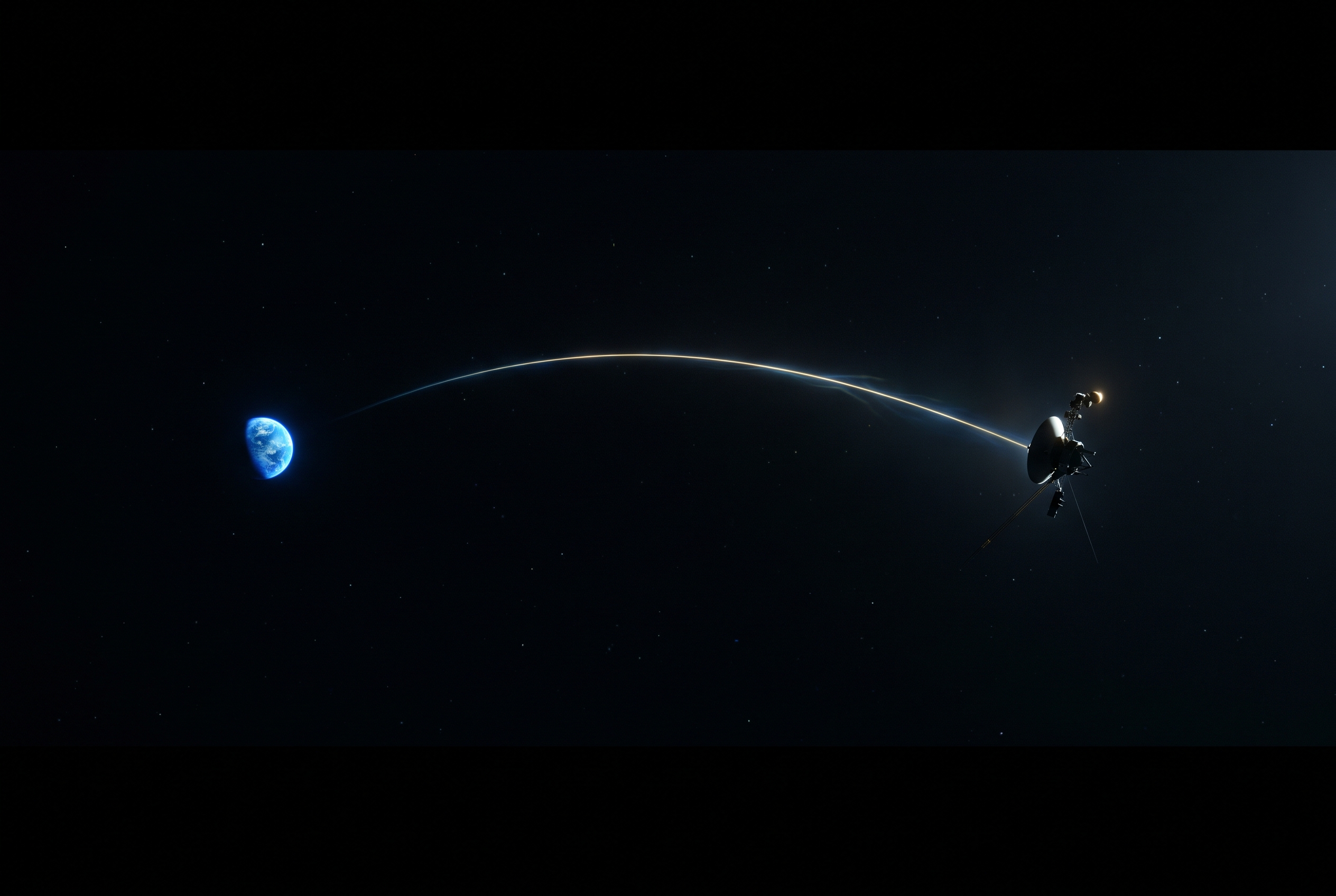
Voyager–1’s radio signal takes a full day to reach Earth: the spacecraft reached a distance of one light-day on 18 November 2026, according to NASA’s Jet Propulsion Laboratory, JPL. That is approximately 25.9 billion kilometres. However, the milestone came amid operational problems: according to the announcement, the spacecraft had already stopped transmitting scientific and engineering data, while its radio carrier signal remained detectable.
A light-day measures distance, but also illustrates the wait
A light-day is the distance light travels through a vacuum in one day, explains the NASA Science guide. It does not refer to the spacecraft’s journey time: Voyager–1 did not travel this far in a single day. The unit is particularly useful because the same number expresses both the distance and the travel time of a radio signal moving at the speed of light.
According to JPL’s account, at this distance the one-way signal travel time is around 24 hours, while a round-trip exchange takes roughly 48 hours. If controllers on Earth send a command, they cannot receive immediate confirmation that it has been carried out. First, the command must reach the spacecraft, and then the response must travel back.
This wait is not like a slow internet connection that can simply be sped up with better data transmission equipment. The signal’s travel time is a consequence of the distance itself. Moreover, the round-trip signal time covers only communication: interpreting the data, planning the next step and carrying out any onboard operations may take additional time.
The milestone and the data transmission fault are separate stories
According to JPL, a data transmission anomaly occurred on 14 November, interrupting the transmission of scientific and engineering data. Engineers confirmed the distance milestone using the carrier signal, which could still be received, and trajectory calculations. The announcement therefore does not claim that all the spacecraft’s systems were operating normally at the time.
A radio signal is not the same as usable measurement data. The carrier signal is the underlying radio signal that can carry transmitted data; detecting it does not, in itself, mean that ground stations are also receiving scientific results. In Voyager–1’s case, its detectable radio signal, data transmission and instrument status must therefore be considered separately.
The Space.com report likewise highlights that the carrier signal continued to be received despite the interruption to the data stream. This is an important distinction from a complete loss of contact, but does not in itself prove that the fault has been resolved. Reaching the milestone and restoring scientific data transmission are separate achievements.
Decades of operation mean scaling back the mission’s tasks
Voyager–1 launched in 1977, so by November 2026 its journey had lasted more than 49 years, as noted in the historical overview of the mission. However, this does not mean it is operating with an unchanged set of instruments or an unchanged power supply. On a mission this long, tasks must be adapted to the capabilities that remain.
According to the Smithsonian Magazine report, the spacecraft is powered by a radioisotope generator using plutonium–238, whose declining output has also made it necessary to limit instrument operation. The publication also cites equipment that no longer works or has been switched off as examples of the mission’s reduced capabilities. Its longevity therefore rests not on an unlimited energy reserve, but on continual adaptation.
The basic principle of a radioisotope generator is to convert some of the heat produced by radioactive decay into electricity. However, power supply and power use are separate issues: generating electricity does not necessarily mean that every piece of equipment can operate at once. In Voyager’s story, engineering achievement is therefore measured not only by the distance travelled, but also by the ability to keep the spacecraft functioning.
Remote troubleshooting cannot rely on improvisation
The roughly two-day round-trip signal time described by JPL creates a very different working rhythm from repairing a nearby device. With a system on Earth, it is possible to test quickly whether a change has worked; here, even the feedback takes time to arrive. If the first step does not provide a clear answer, the next investigation may require another lengthy communication cycle.
The data transmission interruption also makes the situation harder because engineering data would help explain what is happening onboard. There is a substantial difference between detecting a signal and knowing the system’s detailed condition. This illustrates one of the fundamental difficulties of remote operation: sending a command is not enough; it must also be possible to establish what effect it had.
One light-day is not a new boundary in space
Passing the one-light-day mark does not mean crossing a physical wall, nor does it in itself mark the beginning of a new region of space. It is a distance milestone whose particular significance lies in how far a human-made object has travelled. According to the Planetary Society’s account, Voyager–1 is the first artificial object to reach this distance from Earth.
According to NASA Science’s forecast, Voyager–2, which is following a different trajectory, is expected to reach the same milestone in November 2035. This is an estimate, not an event that has already happened. Comparing the two spacecraft also serves as a reminder that similar missions do not necessarily set distance records at the same pace.
Autonomy will also matter for future deep-space probes
Voyager–1’s story makes clear that interstellar exploration is not simply about reaching the greatest possible distance. Equally important are how a spacecraft remains operational, how it meets its power needs and how much useful information it can send home. Long communication delays mean that autonomous onboard operation is also an important consideration when planning future missions to distant destinations.
The milestone announced by NASA thus illustrates both the possibilities and the limitations of technology. The signal from a spacecraft launched decades ago can still be received, but maintaining contact is not the same as flawless scientific operation. This is precisely what makes Voyager–1’s achievement remarkable: it has not only travelled far, but continues to challenge those trying to understand and operate it from Earth.
Sources used
- 1.NASA's Voyager 1 Makes History, Reaching One Light-Day From Earthjpl.nasa.govverified
- 2.Voyager 1: What is a Light-Day?science.nasa.govverified
- 3.Voyager 1 team celebrates epic 1 light-day distance milestonespace.comverified
- 4.NASA's Voyager 1 Has Reached 1 Light-Day From Earthsmithsonianmag.comverified
- 5.Voyager 1 Reaches 1 Light-Dayplanetary.org
- 6.Voyager 1 becomes first spacecraft to reach 1 light-day from Earthedition.cnn.com
- 7.Voyager 1 Reaches One Light-Day Distanceorbitalradar.com
These sources were used during our editorial fact check.