
Tudomány
Sky triangle: spotting Mars, Jupiter and Regulus at dawn
On late November mornings, two planets and a star form a changing triangle in the sky. Here is when and where to look, and why it is worth watching on several mornings.
2026-11-18 · 4 min read
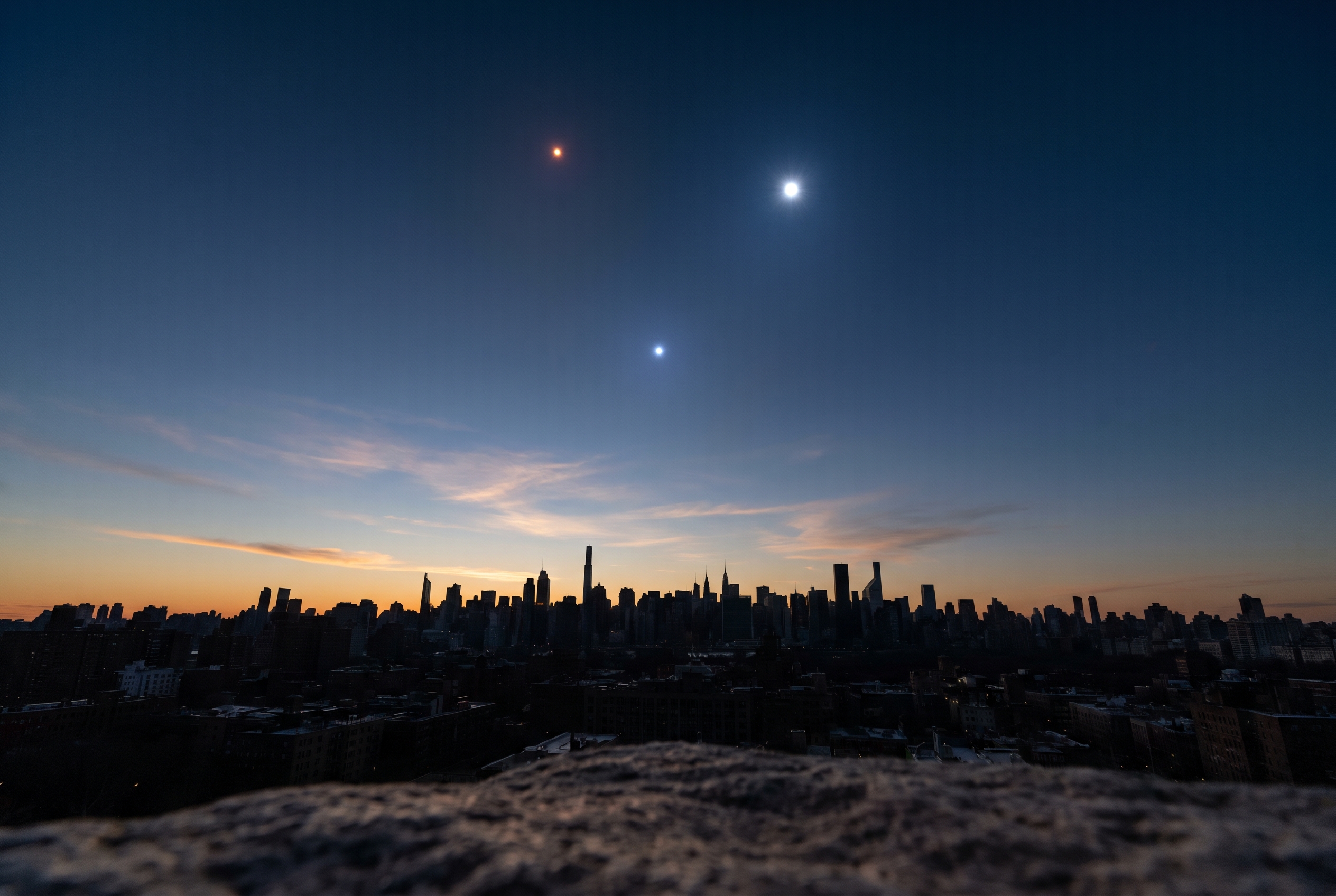
Before dawn on 22 November, look for a nearly isosceles triangle in the southern sky: Mars, Jupiter and Regulus will form the pattern, according to the Svábhegy Observatory’s forecast. You do not necessarily need a telescope: ma7 reports that the trio will also be visible to the naked eye. If you watch on several mornings, you will see a different arrangement each time.
Look south before dawn, rather than just above the horizon
According to the Svábhegy Observatory’s forecast, on 22 November 2026 the triangle will be visible in the southern sky at an altitude of about 55 degrees above the horizon. HVG’s guide recommends observing at around 5.30 am that morning. This is a useful starting point if you want to put a single viewing opportunity in your diary.
An altitude of 55 degrees means you should not be searching along the rooftops: look towards the upper half of the stretch of sky between the horizon and the point directly overhead. Choose somewhere with no nearby building or tree blocking your view to the south. A compass or your phone’s map can help you get your bearings before you set out.
According to HVG, it is worth planning your early-morning viewing for no later than 6 am. So do not prepare as you would for an evening of stargazing: this time, an early start is part of the plan. Check the cloud forecast the evening before, too, because an accurate astronomical forecast does not in itself guarantee clear skies.
Colours can help you distinguish the three points of light
Jupiter may appear as a brilliant white point of light, Mars as reddish and Regulus as bluish-white, HVG reports. According to the publication, their differences in colour and brightness may be noticeable even to the naked eye. As you search, pay attention not just to which three points form a triangle, but also to the visible differences between them.
Do not expect the colours to look like those in a highly saturated astronomical photograph. Instead, look for subtle shades and give yourself time to compare them. One useful approach is to take in the whole pattern first, then look at each of its corners in turn.
The triangle changes shape between 22 and 25 November
According to the Svábhegy Observatory’s description, the three celestial objects will form an obtuse, nearly isosceles triangle on 22 November, but by 25 November the pattern will become right-angled. The latter arrangement is also described in ma7’s guide. In other words, there is more than one brief moment worth getting up for: following the change can be a rewarding observation in its own right.
In an isosceles triangle, two sides appear similar in length, while in a right-angled triangle you can look for an angle at one corner that resembles the corner of a sheet of paper. There is no need to check the sky with a ruler. The point is to notice that the positions of the three points of light relative to one another do not stay the same.
If you would like to compare different mornings, make a simple sketch. Mark the three points and label them with their names, along with the date and time of your observation. Try to watch at a similar time and from the same place: this makes it easier to compare your drawings than to recall the earlier view from memory alone.
Start with the naked-eye view; binoculars are an optional extra
According to ma7’s report, the event can be observed clearly both with the naked eye and through binoculars. There is therefore no need to buy equipment to try to find it. Identify the whole triangle first, then bring out any binoculars you already have if you would like a different view of that part of the sky.
It is worth distinguishing the purpose of this observation from studying details on the planets. The main interest here is the shared arrangement of the three celestial objects and how it changes, rather than how much surface or atmospheric detail you can make out on them. In this respect, a simple observational sketch can be just as useful a record as a photograph.
A conjunction means apparent closeness
The term “conjunction” does not mean that the celestial objects are coming close together in space. They appear in a similar direction when viewed from Earth. It is rather like a nearby lamp and a light on a distant building appearing next to each other in your field of view, even though they are actually separated by a great distance.
The triangle is also a pattern that emerges from our viewpoint. We connect its corners in our minds; no lines actually appear between them in the sky. This makes the event no less interesting: it reveals how the arrangement of celestial objects changes from our perspective.
The Moon joins the view on 30 November
According to the Hungarian Astronomical Association’s events calendar, before dawn on 30 November the waning Moon will also appear near Mars, Jupiter and Regulus, with the four celestial objects forming a group within 9 degrees of one another. The Moon’s arrival is also noted in the Svábhegy Observatory’s event description. Treat this as a separate viewing opportunity, rather than an unchanged repeat of the earlier triangle.
If you have already managed to identify the three celestial objects by then, finding them alongside the Moon can be an interesting challenge. Compare the new arrangement with your earlier sketch and notice how different the same part of the sky looks with another prominent object in view.
The simplest plan: choose a clear morning before dawn, find an unobstructed view to the south and first try to identify the triangle with the naked eye. If you feel inspired, return on another morning. You do not need a ticket or special equipment; the most rewarding part may be not just finding the pattern, but noticing how it changes.
Sources used
- 1.A Regulus, a Mars és a Jupiter égi háromszögeisvabhegyicsillagvizsgalo.huverified
- 2.MCSE Jelenségnaptármcse.huverified
- 3.A Mars, a Jupiter és a Regulus együttállása lesz megfigyelhető novemberbenma7.skverified
- 4.Égi négyesfogat: Mars-Regulus-Jupiter-Hold együttállássvabhegyicsillagvizsgalo.huverified
- 5.Különös háromszög Magyarország égboltjánatv.hu
- 6.Hírmozaik november 17.kultura.hu
- 7.Planetary Alignment November 2026starwalk.space
These sources were used during our editorial fact check.