Praktikus mindennapok és háztartás
Efficient heating: thermostats, airing and foil tips
Lowering the target temperature by 1 °C could save 5–6% in heating energy, according to WWF’s guide. Here is how brief airing, keeping radiators clear and correctly positioning radiator reflector foil can help.
2026-11-26 · 4 min read
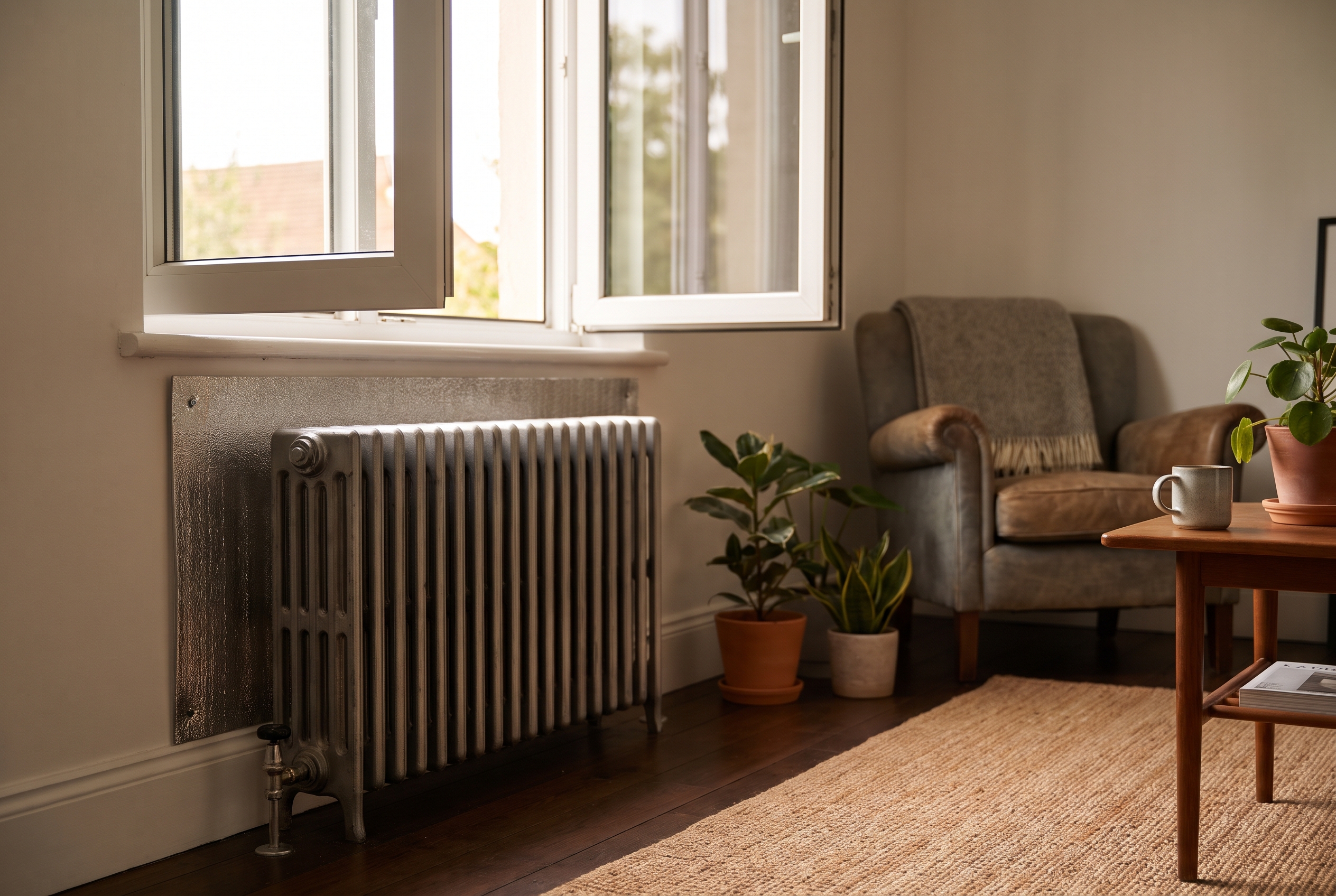
A warm radiator beside a window left tilted open: in this situation, it is worth reviewing your ventilation habits before buying a new device. According to MVM Home&Pro’s advice, brief, intensive airing is more economical than leaving a window tilted open for a long time. Adjusting the thermostat and clearing the area around the radiator can also be good starting points before undertaking bigger jobs.
A 1 °C reduction is worth trying, not a rule for everyone
Lowering the target indoor temperature by 1 °C could deliver heating energy savings of approximately 5–6%, according to WWF Hungary’s LIFE BIO-BALANCE heating guide. This is a useful indication, not a personalised promise: do not treat it as a guarantee of exactly the same result in every home.
In practice, it is worth starting with a small adjustment. If the room feels too warm at the current setting, try lowering the target temperature, then see whether it is still comfortable to spend time there. The aim is not to put up with the cold, but to find the setting that suits you.
Saving heating energy does not mean reducing your total monthly bill by the same proportion. The percentage given in the guide is therefore best understood as an indication of energy use, not a promise about the amount you will pay. Continued comfort cannot be guaranteed in advance either: you need to try it out in your own home.
Air rooms briefly and thoroughly, rather than leaving windows ajar for hours
According to the Hungarian Energy and Public Utility Regulatory Authority’s household guide, the advantage of brief cross-ventilation is that the air can be replaced while the walls and furniture cool down less. The guide mentions 3–5 minutes of intensive airing. Treat this as a starting point, not a timer setting that will produce exactly the same result in every room.
MVM Home&Pro likewise recommends opening windows for a few minutes of intensive airing rather than leaving them tilted open for long periods. The idea is not to prevent any heat from escaping during ventilation, but to achieve the necessary air exchange without prolonged cooling. Brief airing is therefore not a solution without heat loss, but one way to limit that loss.
Try to make opening the windows a deliberate routine: open the window, create a cross-draught where possible, then close it again. This avoids leaving a window tilted open for a long time without noticing. Do not stop ventilating to save energy; change how you do it instead.
Clear the space in front of the radiator before buying accessories
Furniture placed in front of a radiator or a curtain hanging over it can obstruct the circulation of warm air, according to MVM Next’s Energiadiéta advice. It is therefore worth checking what covers the radiator and how clear the surrounding area is. This is a check you can make without immediately choosing new equipment.
Move any curtain hanging in front of the radiator out of the way, and see whether you can leave more space in front of it. Do not just check whether the radiator is visible: consider how crowded its immediate surroundings are too. The point of MVM’s advice is to allow air to move more freely, not simply to make the room look tidier.
Dust build-up is also worth checking. According to a practical article by Háziműhelyed, accumulated dust can impair a radiator’s heat output and airflow between its fins. However, do not use this to predict a specific reduction in your bill: there is no savings percentage from cleaning that applies to every home.
Reflector foil acts on radiant heat; it does not replace wall insulation
Foil behind a radiator serves a different purpose from clearing the space in front of it. According to Masterplast’s overview, the metallised surface reflects radiant heat. As Duralbau explains, this does not eliminate losses through conduction or air movement, and it is no substitute for thick thermal insulation.
The Hungarian Energy Efficiency Institute recommends using reflector foil particularly behind radiators mounted on uninsulated external walls. The aim here is to reduce heat transfer towards the wall. However, do not imagine that the foil will then keep all the heat in the room, with no energy escaping towards the wall.
A wall that already has external insulation is a different situation. According to Háziműhelyed’s account, the additional savings from foil behind a radiator may be much smaller in such a building. Before buying it, check whether the radiator is actually on an external wall and whether that wall has external insulation.
The air gap matters more than a shiny surface
According to Masterplast’s overview, a suitable air gap is needed for the heat-reflecting effect to work. The key is for the reflective surface to face an air space: do not press it directly against another surface. When positioning a product behind a radiator, its design and installation instructions are therefore at least as important as the material itself.
Rather than following a generic installation method assumed to apply to every foil, check the instructions for your chosen product. If fitting it would require removing or modifying the radiator, it is worth consulting a professional. Even for a seemingly simple accessory, there is no need to make improvised changes to the heating system.
Do not treat the expected result from the foil as a guaranteed percentage either. Taken together, MEHI’s recommendation for uninsulated external walls and the account of more limited benefits in already insulated buildings highlight that the same product is not equally useful in every home. Think of it as a targeted addition, not a cheap substitute for insulating the whole home.
Start with changes you can try without buying anything
First, check the area around the radiator, switch to deliberate, brief airing, and try a slightly lower target temperature to see whether it suits you. Reflector foil can then be considered if the wall and installation conditions justify it. This way, rather than relying on an impressive savings promise, you can make separate changes that are easy to try at home, while checking that you remain comfortable.
Sources used
- 1.MEKH Energiahatékonysági Tippek Háztartásoknakenhat.mekh.huverified
- 2.Fűtési Kisokos – LIFE BIO-BALANCE Projektbiobalance.wwf.huverified
- 3.Hőtükör fólia alkalmazása, tudnivalók és lehetőségekmasterplast.huverified
- 4.Hőtükör fólia: hogyan működik és hová kell beépíteniduralbau.huverified
- 5.Hővisszaverő fólia radiátor mögé – ne rontsd elhazimuhelyed.comverified
- 6.Ketyeg a rezsiora: Hasznaljunk hotukorfoliatmehi.huverified
- 7.MVM Energiadiéta Lakossági Tippekmvmnext.huverified
These sources were used during our editorial fact check.