Tech
Super Heavy: why SpaceX's launch tower catch matters
The 2024 catch of Super Heavy showed how a rocket booster could return directly to its launch tower. But a successful return is only the first step towards cheaper spaceflight with faster turnaround times.
2026-11-18 · 5 min read
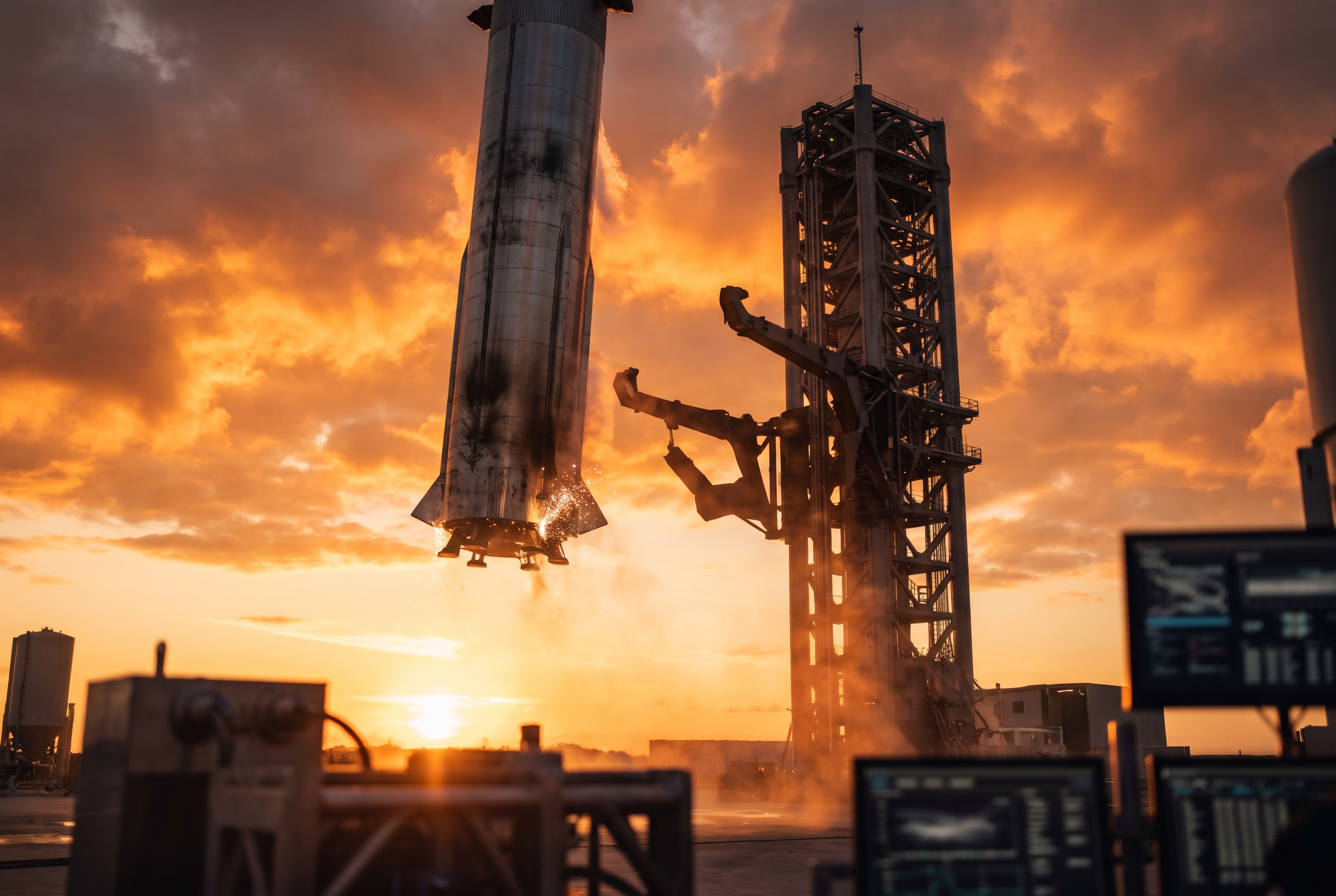
A 71-metre-tall rocket booster returned to its launch tower, where two enormous mechanical arms caught it: according to Space.com, SpaceX's Super Heavy achieved this on 13 October 2024, roughly seven minutes after lift-off. The significance of the spectacular manoeuvre went beyond successfully catching the returning vehicle. The more important question is how much closer this approach could bring spaceflight to the operation of routinely reusable forms of transport.
Catching Super Heavy is not the same as recovering the Starship spacecraft
The names are easily confused, but the distinction is essential to understanding what happened. According to SpaceX's account of the fifth test flight, the tower caught the first stage, called Super Heavy, while the Starship second stage made a controlled splashdown in the Indian Ocean. In other words, the entire system did not return to the launch pad on this flight.
The name Starship is also used for the complete launch system, so this important detail can easily be lost in a short news report. In SpaceX's description, however, the two vehicles performed different tasks and ended their flights in different places. The successful catch of Super Heavy does not, on its own, mean that the second stage was recovered or that the entire system is reusable.
The tower does not simply catch a falling rocket
According to Space.com, Super Heavy reached the tower after a controlled return and braking manoeuvre. The mechanical arms of the tower, known as Mechazilla, were therefore not trying to stop an object in free fall. Instead, they took over supporting the booster during the final stage of its return. This is an important distinction from catching something in the everyday sense.
According to Born to Engineer's technical analysis, hydraulic damping and vibration-absorbing features in the arms also help manage the loads. The catch is therefore not simply a matter of precise positioning: the movements and forces generated at contact must also be managed. Coordinating the operation of the rocket and the ground structure is what makes the solution an engineering challenge.
Thousands of conditions determined whether the manoeuvre could begin
SpaceX said that thousands of conditions relating to the vehicle and the launch pad had to be met before the catch attempt could begin. According to the company's account, the decision therefore depended on more than whether the booster could fly back close to the tower. The receiving infrastructure also had to be in a suitable condition.
This shows why it is misleading to reduce the achievement solely to the movement of the arms. Behind the spectacular finish was the coordinated operation of an entire flight and ground system. In the longer term, the technology's value will depend not only on whether it works in favourable conditions, but also on how reliably it can be repeated and how situations in which a condition is not met can be handled.
Removing landing legs shifts part of the task to the ground
Born to Engineer's analysis highlights one advantage of the approach: support from the tower makes it possible to dispense with landing legs. According to the analysis, this could reduce the mass of the flight vehicle. The principle is that equipment whose work can be done by ground infrastructure does not necessarily need to be lifted with the rocket.
This does not mean that the task simply disappears, however. The booster still has to be supported, just by different equipment and in a different place. Any assessment of the complete system should therefore consider the tower's complexity, availability and upkeep alongside the rocket itself; a lighter flight vehicle alone does not tell the whole operational story.
Faster relaunch is the goal, not an automatic consequence of the catch
According to BBC Sky at Night Magazine's analysis, one of the main promises of returning directly to the tower is faster preparation for another flight. Seen this way, the catch is not a standalone stunt, but a potential part of a shorter ground-handling process. The closer the returning vehicle gets to its next launch site and support systems, the less additional movement may be needed.
It is important, however, to distinguish between returning and being ready to fly again. A successfully caught booster still needs to be assessed to establish its condition and the work required before its next use. The catch therefore does not automatically imply an exceptionally short turnaround time: the decisive measure would be the entire process from return to the next lift-off.
Cheaper space transport requires the entire operating cycle to work
The economic logic of reuse is easy to understand: there may be an advantage in not having to build a complex vehicle from scratch for every mission. But the savings also depend on the resources needed to keep it in service. Bringing it back does not, on its own, establish how much work inspection, repair and preparation for another flight will require.
The tower-arm approach should therefore not be reduced to a single, guaranteed promise of lower costs. A meaningful comparison would require knowing how many times the same vehicle could fly, what work it would need between flights and how frequently it could launch. A successful catch demonstrates an important technical step, not the final price of a fully developed service.
For the same reason, it would be misleading to claim that reuse reduces launch costs to the price of fuel alone. Ground infrastructure, maintenance and operations cannot be left out of an assessment of a functioning transport system. The significance of the spectacular return may become economically measurable when preparation for subsequent flights becomes a predictable process.
Reusability is not the same as proven sustainability
The idea of a recoverable rocket is easily associated with less waste, but its environmental balance is a broader question. Repeated use of a vehicle does not, on its own, prove that the overall activity has a lower environmental impact. Establishing that would require manufacturing, operations, repairs and frequency of use to be assessed together.
It is therefore more accurate to describe the Super Heavy catch as an engineering step towards reuse than as an established environmental achievement. The two claims do not mean the same thing. The former concerns whether a return method works; the latter would require a comparable assessment of the full life cycle.
The real test will be what follows the return
The most important lesson from SpaceX's Super Heavy catch is that direct coordination between a returning rocket and its launch tower is achievable. Cheaper and more regular space transport, however, requires a longer chain to work: return, inspection, preparation and another flight. The booster arriving between the arms is a spectacular stage in that process; the real operational breakthrough would be demonstrated by making the entire process reliably and economically repeatable.
Sources used
- 1.Starship's Fifth Flight Testspacex.comverified
- 2.SpaceX catches giant Starship booster with Mechazilla armsspace.comverified
- 3.SpaceX Starship Test 5: Chopsticks Catch Boosterskyatnightmagazine.comverified
- 4.SpaceX Starship Flight 5 Revolutionary Chopsticks Booster Catchborntoengineer.comverified
- 5.Starship megarocket booster caught by SpaceXphys.org
- 6.Analysts on SpaceX's Starship Catch Milestonestradingview.com
- 7.SpaceX catches Starship rocket booster with chopstick armsreddit.com
These sources were used during our editorial fact check.