
Technológia
Self-driving cars tested in Debrecen with safety drivers
Two electric test cars have appeared on Debrecen’s public roads, according to the University of Debrecen. The Level 4 technology can drive autonomously under specified conditions, but trained safety drivers are supervising its operation during the trials.
2026-11-22 · 4 min read
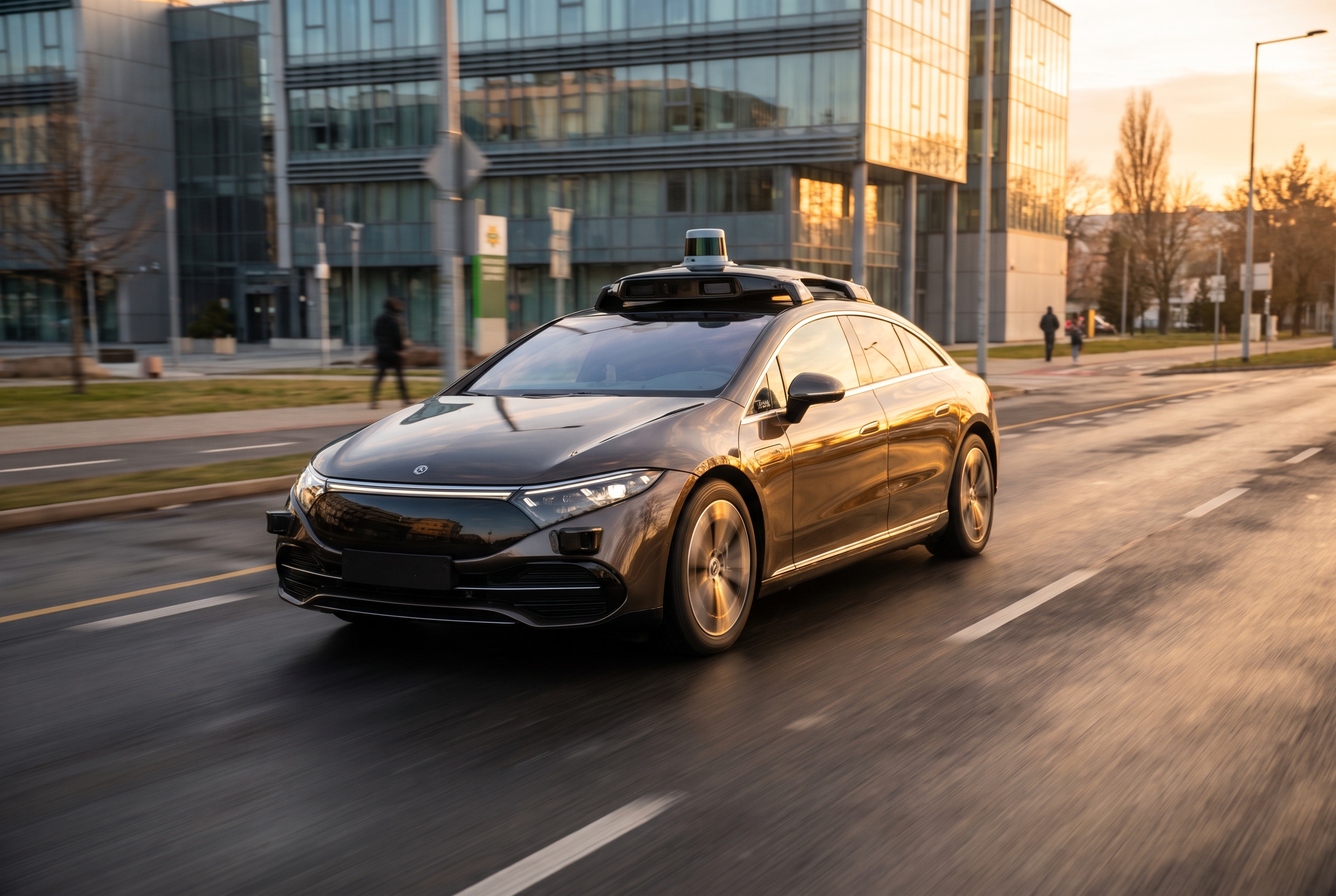
Public-road testing of two self-driving electric passenger cars began in Debrecen on 16 November 2026, but trained safety drivers remain behind the wheel, according to a statement from the University of Debrecen. The university’s Faculty of Engineering is participating as a technical partner in the trials of the Level 4 vehicles. This combination highlights the significance of the development: technology designed to drive autonomously is being tested, for now under continuous human supervision.
The Debrecen programme raises questions beyond whether a car can steer itself. Equally important are the conditions under which it can travel autonomously, how its operation is monitored, and what separates a public-road trial from a future passenger service.
Level 4 does not mean a car can cope everywhere
According to 24.hu’s technology report, the defining feature of Level 4 is that a vehicle can accelerate, brake, steer and handle traffic situations without human intervention under specified operating conditions. Those specified conditions are not a minor qualification: they define the limits of its capabilities. It would therefore be misleading to interpret the classification as a promise of autonomous driving on every road and in every situation.
PubliQo’s explanation links this to the concept of the ODD, or Operational Design Domain: the conditions within which a system is designed to operate. In plain terms, the question is not simply whether the car can drive, but under what conditions it can be expected to operate autonomously. Test results should also be interpreted with these limits in mind.
The safety driver monitors the system and can take control
According to the university, every test car carries a specially trained safety driver. They continuously monitor the system’s operation and can immediately take control if anything goes wrong. The Debrecen trials therefore do not involve cars travelling with an empty driver’s seat.
This is not a contradiction, but a distinction between two separate issues. The Level 4 designation describes the technology’s capabilities under specified conditions; the presence of a safety driver describes how the current testing is organised. A human’s presence does not, in itself, mean the vehicle is incapable of autonomous driving, just as the classification does not mean supervision is unnecessary during the trials.
The Vehicle Laboratory on Vezér Street is the base for the Debrecen trials
According to the University of Debrecen, the vehicles depart from and return to the Vehicle Laboratory at the innovation park on Vezér Street. The statement describes electric passenger cars with green stickers and distinctive markings. The Faculty of Engineering’s technical involvement provides the university support behind the tests visible on public roads.
Electric propulsion and automated driving are two separate characteristics here. The former describes what powers the vehicle; the latter describes how it performs driving tasks. The technological interest of the Debrecen programme therefore lies not simply in the appearance of electric cars, but in the testing of their autonomous driving capabilities.
Public-road trials focus on operational reliability
According to 24.hu’s report, an important task of the trials is to assess reliable operation under different traffic and weather conditions. This is a different question from demonstrating that the system can perform a manoeuvre autonomously on a particular occasion. How consistently it operates under the specified conditions also matters when assessing the technology’s development.
A striking turn or a successful braking manoeuvre alone therefore does not demonstrate the significance of the testing. The central question is what conclusions can be drawn from the observed operation about the technology’s usability. To do this, it is worth distinguishing between situations handled autonomously and cases requiring human intervention.
Debrecen is part of a Hungarian programme planned across several locations
According to an earlier overview by Moneybuzz, the Hungarian testing programme builds on closed-track trials at ZalaZONE. In the sequence outlined by the publication, these are followed by public-road testing in Zalaegerszeg, then Debrecen and, later, Budapest. That report presents the Budapest phase as a planned continuation, not as an event confirmed to be taking place at the same time as the Debrecen launch.
This background helps put the latest news into context: the reports describe a series of tests building on one another, rather than a single, isolated vehicle demonstration. Hungary’s role in this story centres on gathering testing experience. The presence of these vehicles on public roads is an important development, but does not in itself prove that the technology can be introduced into everyday traffic without restrictions.
Robotaxis are a possible next step, not another name for the current trial
PubliQo links the Debrecen trials to laying the technological foundations for future self-driving taxi services. This identifies a possible application: a service in which an automated system performs the driving tasks. However, the start of public-road testing cannot be equated with the launch of a robotaxi service available to passengers.
The distinction also matters in everyday terms. News about development shows what capability is being tested; a service announcement would also need to explain where, under what conditions and by whom it could be used. References to robotaxis should therefore be understood as a future possibility, not as a promise that automatically follows from the current Debrecen trials.
Test results could reveal the extent of real progress
The most important aspect of the Debrecen programme is not that the cars have been labelled “self-driving”, but that automated driving is being examined in a public-road environment. Three concepts together accurately describe the current situation: specified operating conditions, trained safety drivers and test operation. Considering them together helps avoid both underestimating and overestimating the technology.
The next substantive question will be what the trials demonstrate about the system’s reliability and applicability. For the future of transport in Hungary, this experience may ultimately reveal more than the Level 4 label alone. In Debrecen, the practical examination of these questions has now moved closer to everyday traffic.
Sources used
- 1.unideb.huhirek.unideb.huverified
- 2.publiqo.hupubliqo.huverified
- 3.moneybuzz.humoneybuzz.huverified
- 4.raketa.huraketa.hu
- 5.hungarytoday.huhungarytoday.hu
- 6.penzcentrum.hupenzcentrum.hu
- 7.24.husokszinuvidek.24.hu
These sources were used during our editorial fact check.
Related Articles



Latest Articles

Zene és Koncert
André Rieu Budapest 2027: concert and ticket information
2026-11-22 · 4 min read

Igényelhető támogatások és kedvezmények
December pension arrives on 2 December: plan to January
2026-11-22 · 4 min read

Magyar film / Mozipremier
Hogyan tudnék élni nélküled? 2. breaks 29-year record
2026-11-22 · 4 min read