
Egészséges életmód és megelőzés
10-minute post-meal walks and fermented foods: evidence
A short walk after a meal may help moderate blood sugar levels, while fermented foods may increase gut microbial diversity. Neither is a miracle solution: we explore what the studies suggest and how to turn these ideas into simple everyday habits.
2026-11-23 · 4 min read
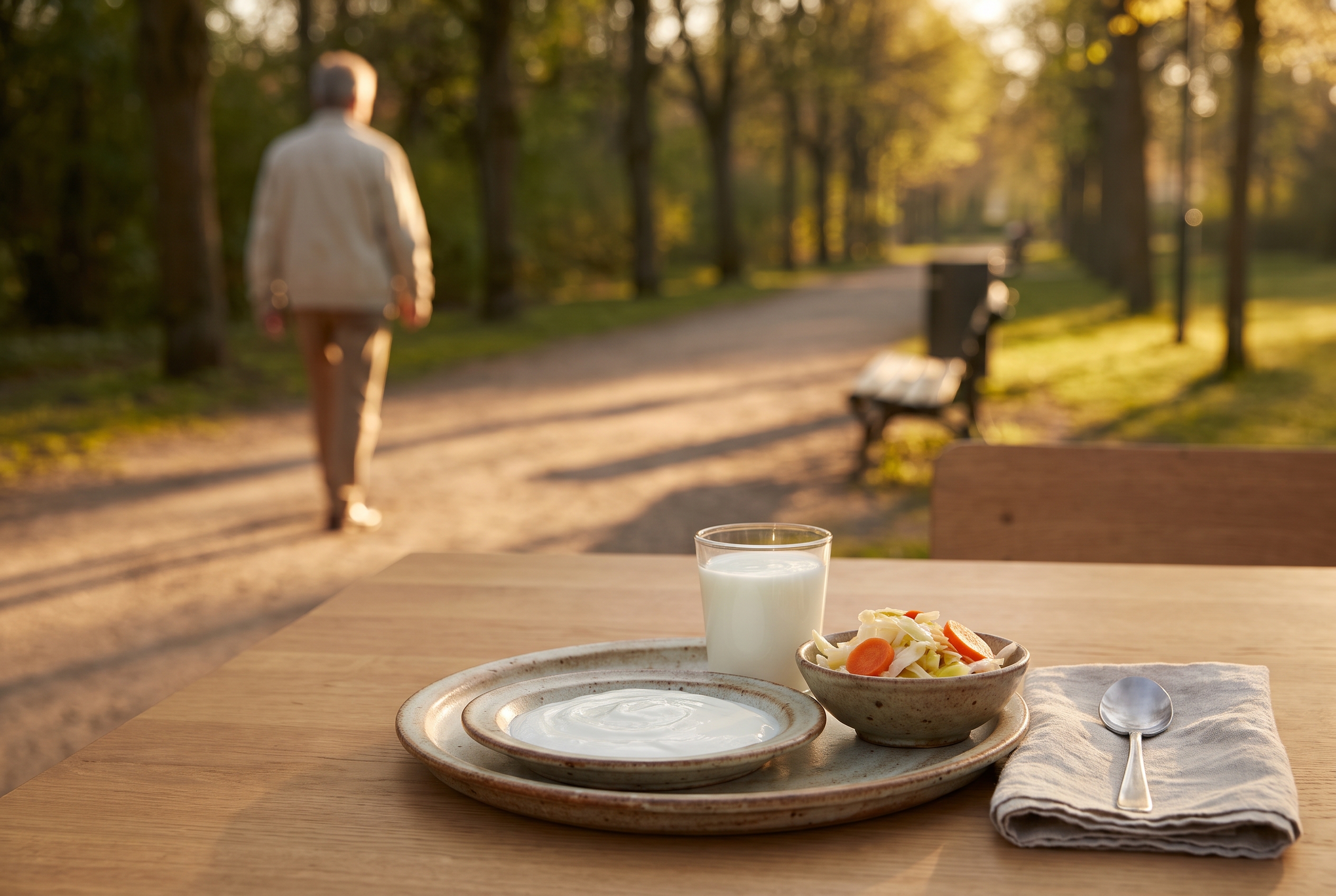
Just 10 minutes of gentle walking started immediately after a meal may help reduce the rise in blood sugar, according to a study examining brief post-meal activity. Meanwhile, another study on fermented foods reported greater gut microbial diversity and reductions in certain inflammatory markers. These are promising findings, but they do not prove that two simple habits can replace an overall diet or guarantee a longer life.
A short walk counts even if it is not a workout
The advantage of walking in this context is its simplicity: it requires neither a gym membership nor a dedicated exercise programme. A short walk around the block after a meal is an option worth considering without completely rearranging your day. The aim is not exhaustion, and there is no need to turn every walk into a test of performance.
According to the study on short walks, even gentle activity begun immediately after consuming carbohydrates led to a more favourable post-meal blood sugar response. This is a narrower claim than saying that walking “resets your metabolism”: the research provides information about blood sugar changes measured in a particular setting. Nor does the finding mean that everyone can expect the same effect.
Ten minutes is a starting point, not a universal prescription
Not every study examined the same walking routine. In a study described by the US Agricultural Research Service, for example, three 15-minute walks after meals improved daily blood sugar control in older participants at risk of elevated blood sugar. This should not be conflated with the experiment examining shorter bouts of activity.
The different durations do not necessarily contradict one another: they may reflect different exercise programmes and participant groups. A favourable result from one study does not, on its own, establish the ideal walking duration for everyone. When planning everyday routines, a short, manageable walk can therefore be the starting point, rather than meeting a supposedly universal target number of minutes.
Fermented foods produced measurable changes, not miracles
Fermented foods, which are made through fermentation, include kefir, yoghurt and various fermented vegetables. According to a Stanford University report, a study involving 36 healthy adults found that a diet rich in fermented foods increased gut microbial species diversity over ten weeks. Participants' diets included yoghurt, kefir and fermented vegetables, among other foods.
The same university report described reductions in the levels of 19 inflammatory proteins in the group eating fermented foods, including interleukin-6. The findings are detailed in a study published in the journal Cell. These are laboratory markers, however: changes in them are not the same as curing a disease or proving that diseases will not develop later.
Gut microbial diversity is not the same as symptom-free digestion
The microbiome refers to the community of microorganisms living in the body; in this case, the research focused on microbes living in the gut. The study described by Stanford found changes in the diversity of this community with the consumption of fermented foods. This does not automatically mean that every participant experienced noticeably better digestion, or that any fermented food can resolve a particular symptom.
Nor is there any justification for presenting fermented foods as an alternative to fibre. The study published in Cell showed different responses to two dietary approaches; it did not establish an overall health ranking of all foods. A short-term change in the microbiome is not a sound basis for cutting out entire food groups.
No special product bundle is needed to fit these habits into daily life
The practical question is where a small change can fit into an existing routine. For walking, this might be a short period after lunch or dinner; for fermented foods, it could mean adding something to a familiar meal. There is no need to overhaul every meal and every shopping trip straight away.
- Give walking a specific place in your day: for example, after one of your regular meals, when a short walk will genuinely fit.
- Choose an everyday food: this could be kefir or yoghurt you already buy, or a fermented vegetable you enjoy.
- Adding more is not the only option: consider which planned purchase a fermented food could replace.
- You do not have to start everything at once: try the changes separately to see which fits more easily into everyday life.
Walking need not involve a separate activity fee, but fermented foods are not necessarily free. It is therefore unhelpful to treat the whole approach as a free health programme. The aim is to find a manageable change, rather than draw up yet another compulsory shopping list.
There is no proof that these two habits are better than every diet
The effect of a short walk on blood sugar and the microbiome changes observed with fermented foods are two separate research findings. The cited studies do not establish that combining them is more effective than every restrictive diet, guarantees weight loss or extends life. Nor do they suggest that other aspects of physical activity and diet become unimportant.
If you have a diagnosed condition, take medication or have persistent digestive symptoms, it is worth discussing lifestyle changes with your doctor or a dietitian. Walking and food choices do not replace prescribed treatment. This guide provides general information, not personalised medical or dietary advice.
The realistic goal is not to follow a recipe for longevity, but to find a simple, manageable habit. A short walk after a meal and the inclusion of fermented foods may offer ideas for doing so. The research gives us reason to take an interest, but it is important to distinguish the favourable changes measured from the sweeping promises these studies have not substantiated.
Sources used
- 1.Gut-microbiota-targeted diets modulate human immune statuspubmed.ncbi.nlm.nih.govverified
- 2.Three 15-min Walks After Meals Improve 24-h Glycemic Controlars.usda.govverified
- 3.Effect of short postprandial walking on glucose excursionspmc.ncbi.nlm.nih.govverified
- 4.Fermented-food diet increases microbiome diversity, lowers inflammationmed.stanford.eduverified
- 5.Fermented foods: Should they be part of your diet?harvardhealth.org
- 6.Simple 10-minute post-meal habit to control blood sugareconomictimes.indiatimes.com
- 7.Fermented Foods, Gut Microbiome and Inflammation Studymoveforwardnaturalhealth.com
These sources were used during our editorial fact check.