Ingatlan
Ganz81 student residence: community housing model
An affordable student residence and community spaces are being created in a former industrial building at Budapest’s Ganz-MÁVAG site. Ganz81 is not a conventional property development: its non-profit model involves users and aims to keep housing costs affordable over the long term.
2026-10-18 · 5 min read
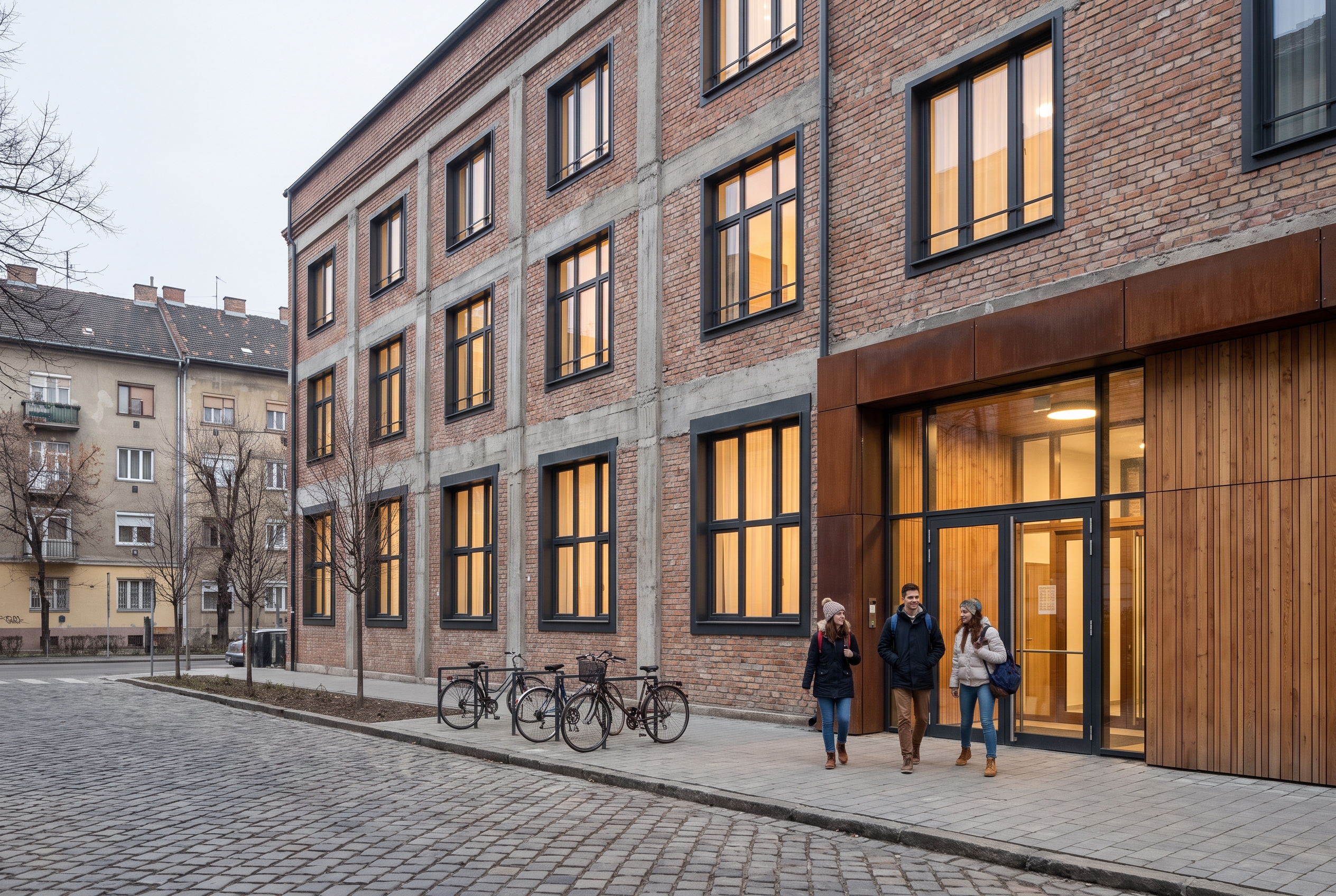
Budapest’s housing difficulties cannot be addressed solely through new public or market-led developments. Ganz81 shows how a disused industrial property can take on a new role under community ownership, with affordable housing rather than profit from rising property values at the heart of the development.
The initiative at the Ganz-MÁVAG site in Józsefváros combines a student residence, study areas and community workspaces. Its significance therefore extends beyond the number of places created: it provides a tangible example of a property development model that is still relatively uncommon in Hungary.
An old industrial building takes on a housing role
According to the Alliance for Community Property Development (SZaKI), Ganz81 is a brownfield development that reuses an existing building at the Ganz-MÁVAG site in Józsefváros. The aim is to create a community-owned, non-profit property for the College for Advanced Studies in Social Theory (TEK) and its partner organisations.
SZaKI’s information describes a student residence with 48 places. Some media reports round this figure to 50, but the developer organisation’s precise figure indicates that 48 places should be used. SZaKI also says that the development will provide space for community workplaces.
The essence of the brownfield approach is that development begins not by building on an untouched site, but by converting a property previously used for another purpose. This alone, however, does not make a project community-based: what distinguishes Ganz81 is the way ownership, financing, decision-making and use are linked.
What do residents receive?
According to TEK’s information about Ganz81, the student residence occupies around 900 square metres on the second floor of Building 81. The residential area includes 14 rooms with two, three or four beds, as well as a shared kitchen, study rooms, communal spaces and bathroom facilities.
This layout is not based on self-contained studio flats. Private living space is complemented by several shared facilities, meaning the model aims to provide both housing and a functioning community environment. Residents may therefore also play a role in shaping the rules of everyday communal living and maintaining shared spaces.
In this system, communal areas are not merely convenient additions. They allow housing, studying, programme organisation and collaborative work to take place within one building, while reducing the amount of space reserved exclusively for each resident.
Neither a conventional dormitory nor a market rental
By SZaKI’s own definition, this is not a speculative property development. The organisation presents the initiative as a model based on grassroots democratic principles, in which users participate in both planning and operation.
In this context, its non-profit character means that the property’s primary purpose is to meet community needs rather than increase profits for its owners. The Periféria Centre for Public Policy and Research’s overview describes non-profit property development as an alternative to the profit-driven property market.
The model must nevertheless cover the costs of acquiring, converting, operating and subsequently maintaining the property. Non-profit operation therefore does not mean free housing, but rather that revenue is not governed by the goal of maximising market returns. Long-term affordability also depends on how the organisation manages financing and building maintenance.
Housing fees are not the same for everyone
There is a discrepancy between the publicly stated monthly fees. A HVG report published on 17 October 2026 mentions a monthly fee of HUF 55,000 for students at the college for advanced studies, while TEK’s information gives a monthly amount of HUF 70,000.
The two figures do not necessarily apply to the same group of residents or the same pricing arrangement. Based on descriptions of the project, the discounted fee for internal members of the college for advanced studies may differ from the amount paid by external residents. Before applying, eligibility conditions, what the fee includes and any additional costs should therefore be checked directly in the operator’s latest information.
The difference also highlights an important question for the community model: how can discounted housing be provided for a defined group while accommodating external residents and operating the building in a financially sustainable way? The answer may lie not in a single low price, but in a transparent fee structure that remains viable over the longer term.
A civil-society response to the shortage of dormitory places
According to HVG, around 10 per cent of students studying in the capital obtain a place in a dormitory. This figure reported by the publication illustrates why solutions outside the public and university systems are gaining prominence, particularly for those who find market rents too burdensome.
Ganz81 may also give TEK institutional independence. According to a report by Józsefváros Újság, the development began as a form of rescue operation after the organisation’s places at Corvinus University’s former dormitory on Ráday Street were steadily reduced. The local publication says the building at the Ganz Holding site was renovated by Gólya Építők.
The scale of the civil-society initiative does not, of course, remove the need for broader housing policy and dormitory development measures. A single student residence cannot solve Budapest’s student housing problems. It may, however, provide a model that other communities and non-profit organisations can test.
Community ownership protects the project’s original purpose
In the conventional property market, an increase in the value of a renovated building may be reflected in higher rents or a higher sale price. Under community ownership, by contrast, organisational rules can be established to keep the property permanently dedicated to its designated social purpose.
This arrangement may matter not only to current residents. If the building remains within a non-profit framework, others may use it on similar terms after one generation of students moves out. Affordability thus becomes not a one-off concession, but a goal embedded in the property’s operation.
The model also requires responsible decision-making. It must define who may move in and under what conditions, how community decisions are made, how maintenance reserves are built up, and what happens in the event of conflict. Grassroots democratic operation offers greater participation, but also requires time and cooperation from users.
The concept has also received international attention
According to a report by Refresher, SZaKI and TEK’s plan entitled “Collective Ownership for Communities” won a New European Bauhaus Award. The publication also reported that the project followed six years of preparatory work and aimed to create a multifunctional centre guided by sustainability considerations.
The recognition does not in itself prove the model’s long-term financial or organisational success, but it indicates that an approach combining community ownership, the reuse of existing buildings and socially focused design has also attracted international attention. The real test will be how the building operates after residents move in and whether its original aims can be maintained.
Ganz81’s value will be shown by its long-term operation
The project’s most important lesson is not that every disused industrial building can be converted into a dormitory. A property’s condition, location, legal status, renovation needs and ability to secure financing differ in every case. Instead, Ganz81 provides an example of how future users of a housing development can be not merely tenants, but also participants in decision-making.
The initiative simultaneously reuses an industrial property, creates student accommodation and seeks to remove the building permanently from speculative logic. Whether it can become a solution that is replicated more widely may depend on operational experience, financial sustainability and other communities’ ability to adapt the model. In any case, Ganz81 shows that housing can be viewed not only as an individual search for a rental home, but also as collectively organised infrastructure.
Sources used
- 1.SZaKI hivatalos oldalszakiszovetseg.huverified
- 2.Ganz81 diákotthon tájékoztatótekesek.huverified
- 3.Mi lenne, ha a lakhatás nem magányos küzdelem lenne?hvg.huverified
- 4.Ingatlanfejlesztés közösségi alaponjozsefvarosujsag.huverified
- 5.Nonprofit ingatlanfejlesztésperiferiakozpont.huverified
- 6.New European Bauhaus díjat nyert egy magyar projektrefresher.huverified
- 7.Rohadt drága kollégiumban laknimerce.hu
These sources were used during our editorial fact check.