
Zöld technológia
BVR-19 splits water with sunlight, but industry is far off
Researchers at Oregon State University have presented a crystalline material that can produce hydrogen from water using light, without an expensive noble-metal catalyst. It is a promising laboratory result, but industrial use is still a long way off.
2026-10-11 · 5 min read
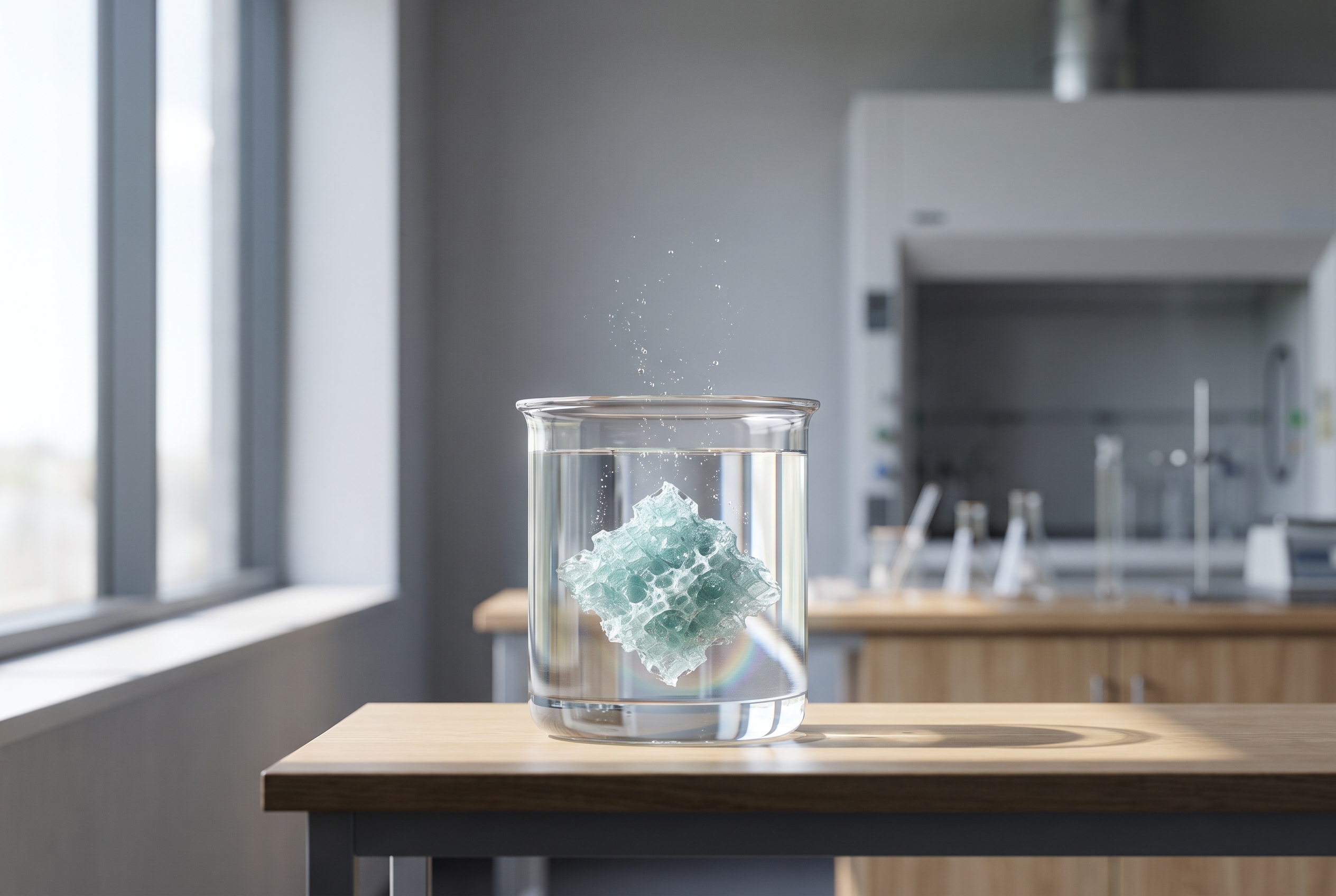
Researchers at Oregon State University have presented a crystalline material that, according to the university's announcement, can produce hydrogen from water using sunlight without an expensive noble-metal catalyst. The result points towards making green hydrogen cheaper, but for now it is a laboratory breakthrough. We have summarised how the material works, why the field is paying attention to it, and what is still missing before it can be used at an industrial scale.
What have the researchers developed?
The new material has been designated BVR-19 and belongs to the family of metal-organic frameworks, or MOFs. According to Oregon State University's announcement, the crystal splits water without a noble-metal catalyst, releasing hydrogen in the process. Based on the announcement, the results were published in the peer-reviewed Journal of the American Chemical Society (JACS).
Metal-organic frameworks are ordered, often porous crystalline materials made up of metal ions and organic linker molecules. According to ScienceDaily's report, one major advantage of such materials is that they can be designed precisely at the molecular level, meaning researchers can shape their properties building block by building block.
According to The Times of India report, BVR-19 forms spontaneously in aqueous solution at room temperature. If later studies also show that this means straightforward production, that could be important from a manufacturability perspective as well.
How does light become hydrogen?
The essence of photocatalytic water splitting is that a material absorbs the energy of light, and the excited electrons produced in this way help form hydrogen molecules from water. In conventional solutions, one separate component often handles light absorption, while a separate catalyst — often a noble metal — helps the hydrogen evolve.
According to reports by SciTechDaily and Impactful Ninja, what makes BVR-19 distinctive is precisely that the sulphur-containing organic building blocks in its structure absorb the light themselves and move the electrons themselves for hydrogen evolution. The Times of India describes this as a novel sulphur-based photomechanism.
Based on the SciTechDaily article, the process therefore eliminates separate electrocatalytic or expensive metal-catalyst steps. Put more simply, the same material carries out both the light harvesting and the chemical work, which could in principle enable simpler and cheaper systems.
Why does it matter that it contains no noble metal?
One long-standing problem in photocatalytic and electrochemical hydrogen production is that many of the most efficient catalysts rely on expensive and rare noble metals. This increases equipment costs, and at large scale raw material supply can also become a constraint. Oregon State University's announcement therefore highlights that BVR-19 works without noble metals.
Cost is a key issue because hydrogen today is typically produced from fossil sources, mainly natural gas; this is known as grey hydrogen. The SciTechDaily article also addresses the fact that green hydrogen produced with renewable energy is generally more expensive than grey hydrogen. Any solution that reduces the cost of producing green hydrogen could narrow the cost gap between the two types and make green hydrogen more competitive.
Where would clean hydrogen be used?
Many people primarily know hydrogen as a fuel for vehicles, but its role is much broader than that. According to ScienceDaily's report, hydrogen is also a key feedstock in the following areas:
- in fuel cells for vehicles,
- in ammonia production, which underpins fertiliser manufacturing,
- in metal refining,
- in plastics production.
Because these industries today largely use fossil-based hydrogen, a cheap and clean production method could play a role not only in transport but also in reducing emissions from heavy industry.
What is still missing for industrial use?
It is important to stress that BVR-19 is still only a laboratory result. According to Impactful Ninja, broader laboratory and engineering testing is needed for industrial-scale implementation. In materials science, there is often a large gap between laboratory and industrial-scale operation, so the initial results do not yet mean the technology will reach the market in the short term.
Based on the reports published so far, several key questions remain open:
- Durability: it is not known how long the material can operate under continuous sunlight and in an aqueous medium without its performance deteriorating.
- Manufacturability: it remains unclear whether the crystal can be produced in large quantities with consistent quality.
- Costs: it is not known how much investment would be needed to build an industrial-scale photoreactor.
Only further research and experimental installations can answer these questions. Until then, BVR-19 shows more where it may be worth moving next than that a finished solution is already here.
What does this mean for the green transition?
BVR-19 is noteworthy because it targets two long-standing obstacles at once: expensive noble-metal catalysts and complex, multi-step systems. If further tests confirm its stability and large-scale manufacturability, the material could help make sunlight-produced hydrogen more competitive. The most important takeaway, however, is that this is a promising, peer-reviewed scientific result, not an immediately available, cheap energy source.
Sources used
- 1.eurekalert.orgeurekalert.orgverified
- 2.sciencedaily.comsciencedaily.comverified
- 3.impactful.ninjaimpactful.ninjaverified
- 4.indiatimes.comtimesofindia.indiatimes.comverified
- 5.scitechdaily.comscitechdaily.comverified
These sources were used during our editorial fact check.