
Zöld & Életmód
Water Retention: What It Means for Homes and Farms
A leadership change has taken place at Hungary’s General Directorate of Water Management as retaining water in the landscape becomes central to water policy. The shift could matter for communities, homes with gardens and agriculture, but no specific rules for households have yet been announced.
2026-11-02 · 5 min read
István Láng has stepped down as head of Hungary’s General Directorate of Water Management, while preparations are under way for a comprehensive shift in water management policy. According to Portfolio’s report, the emerging long-term strategy will focus primarily on retaining water rather than draining it away quickly.
This direction could involve more than building a few new reservoirs. Retaining rainfall locally, protecting water reserves in the soil, and adapting communities and agricultural land could all play a role. However, the details of implementation are not yet known, so it is too early to speak of new obligations for households or farmers.
The new direction was announced alongside a leadership change
According to HVG’s report, István Láng voluntarily resigned as director-general of the General Directorate of Water Management. The publication wrote that his nearly four-decade career had been built primarily around drainage and flood protection, but the changing climate now requires a different approach.
Media reports do not give an entirely consistent account of the reasons behind the resignation. Articles presenting the ministry’s statement emphasised mutual agreement and the need for a change in professional direction, while HVG, citing industry sources, also reported that criticism over the handling of the summer drought may have played a part in the decision.
Until a new director-general is appointed, József Gacsályi, deputy director-general for technical affairs, will lead the General Directorate of Water Management in an acting capacity, Portfolio reported. According to 24.hu’s report, László Gajdos, the minister responsible for the living environment, called for a fundamental change in approach, and the ministry indicated that an open call would be issued for the director-general position.
The announcement therefore concerns both a leadership change and a reordering of water management priorities. According to the reports, the new head will be expected to treat water retention as a priority.
What does water retention mean?
One of the principal aims of conventional water management has been to remove excess water from communities and agricultural land as quickly as possible. This can remain important during floods or periods of excess inland water, but water retention examines how some rainfall can be stored safely for drier periods.
In practice, this may involve several complementary solutions. These can include storing water in natural depressions in the landscape, improving the soil’s capacity to absorb water, preserving wetlands, and managing rainfall runoff from paved surfaces locally. Not every solution is suitable everywhere: local conditions, the risk of water damage and neighbouring properties must also be considered.
The essence of the change in approach is not that all water must be retained under all circumstances. Rather, rainfall should not automatically be viewed as a problem to be removed, but also as a resource that may be needed later. Safe drainage and sensible storage are therefore not necessarily opposites.
In its article about the announcement, HVG wrote that drought had created a shortfall in Hungary’s water reserves equivalent to roughly seven times the volume of Lake Balaton. As this comparison comes from a secondary source, it illustrates the scale of the situation rather than providing a measure that households can interpret directly.
What might a family living in a house with a garden notice?
The strategic direction does not in itself create any new responsibilities for property owners. In the longer term, however, greater attention may be paid to ensuring that rainfall does not place a simultaneous burden on drainage systems, but instead remains on the property in a controlled manner or drains away more slowly.
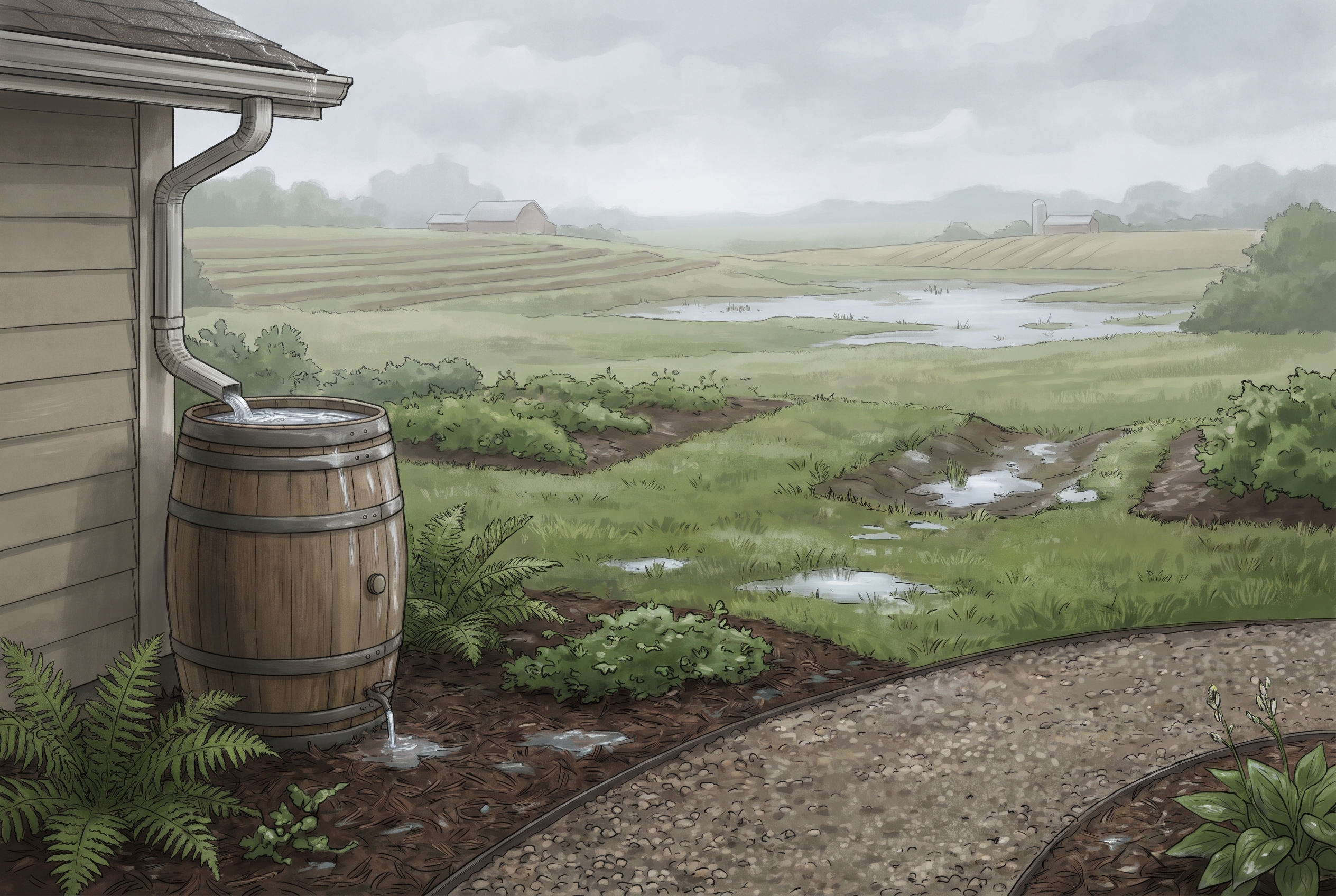
One familiar way to achieve this is to collect rainwater. Water from a barrel or tank can, for example, be used to water ornamental plants if its quality and the plants’ requirements allow. The container should be stable, covered, fitted with an overflow and maintained regularly; before deciding on a particular design, it is advisable to check local rules and the property’s technical characteristics.
Garden design also affects how quickly rainfall drains away. Vegetated soil, organic mulch and avoiding unnecessarily extensive continuous paving can generally slow surface runoff. However, directing water into a garden is only appropriate where it will not soak the building’s foundations, cause standing water or place a burden on neighbouring property.
Possible steps for households include:
- collecting rainwater from gutters in a controlled way and using it in the garden;
- ensuring that the tank’s overflow drains safely;
- keeping soil covered with mulch or vegetation;
- favouring permeable surfaces where technically appropriate;
- adjusting the timing and volume of watering to the plants and the condition of the soil.
These are general options, not personalised technical advice. Before installing a larger tank, soakaway or undertaking landscaping work, it may be appropriate to seek information from a specialist and the relevant local authorities.
Agriculture may require field-level planning
Agricultural water retention is not simply about a farm storing more water. Other important questions include how much rainfall the soil can absorb, how much evaporates and how quickly water leaves a field. Soil structure, compaction, plant cover, topography and the condition of the drainage system can all play a role.
General farming options may include increasing soil cover, protecting organic matter content, reducing compaction and slowing runoff on sloping land. Their appropriate use always depends on local conditions: a measure that is useful on sandy soil may produce different results on heavy soil or land at risk of excess inland water.
Water retention beyond individual fields is an even more complex issue. The operation of a ditch, reservoir, depression or area that can be flooded periodically may affect several plots of land and the surrounding water system. Such an intervention should therefore not be planned solely from the perspective of one farm; consultation on water management, soil science and, where necessary, nature conservation may also be required.
The most important short-term step for farmers may be to assess the water balance of their own land: where rainfall runs off quickly, where the soil is compacted, and which areas regularly experience water shortages or standing water. This assessment could help ensure that interventions aligned with future funding schemes or programmes are not isolated investments.
The specific rules are not yet known
The direction outlined so far is a policy objective, not a detailed implementation programme. Media reports do not contain specific requirements for households or agriculture, funding amounts or deadlines. It would therefore be premature to claim that households will be required to install storage tanks or that farmers will have to carry out specified water-retention investments.
The real change will become apparent when programmes, financing conditions and implementation rules are attached to the strategy. It will also be important to see whether urban rainwater management, agricultural water management, nature conservation and flood safety can be coordinated.
The direction is clear, but implementation will be decisive
The growing emphasis on water retention signals a fundamental change in approach: the aim may be to keep more rainfall safely in the landscape, soil and local systems. For homes with gardens, this could encourage smaller local solutions, while in agriculture it may promote coordinated, area-based planning.
However, the announcement does not yet create any direct obligation for households or farmers. In the meantime, households can consider low-risk methods suited to their property, while it is advisable to wait for detailed rules before undertaking larger interventions and to consult a specialist where necessary.
Sources used
- 1.hvg.huhvg.huverified
- 2.portfolio.huportfolio.huverified
- 3.24.hu24.huverified
- 4.pecaverzum.hupecaverzum.hu
- 5.atv.huatv.hu
- 6.telex.hutelex.hu
- 7.vg.huvg.hu
These sources were used during our editorial fact check.