Gazdaság & Logisztika
Paks shipping closure: could freight costs rise?
Low water levels on the Danube and the shipping closure at Paks have removed a significant volume of goods from river transport. Switching to roads may cost more, but this does not automatically mean a general rise in retail prices.
2026-10-17 · 5 min read
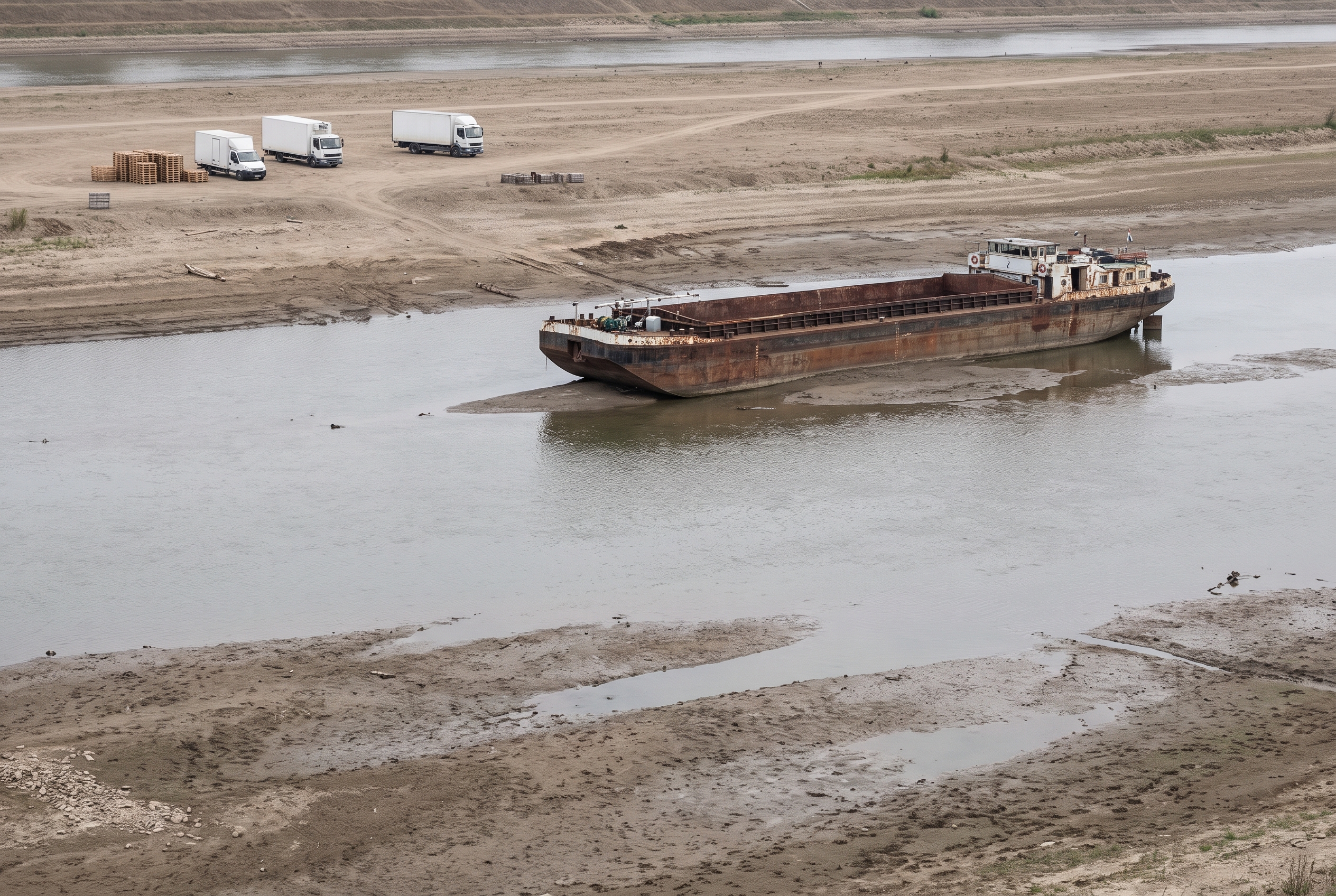
Low water levels have caused disruptions to freight transport on the Danube, while a full shipping closure is in force at Paks. Some of the displaced traffic can be redirected to roads, but this is difficult because of higher freight costs and limited lorry and driver capacity.
The change primarily affects the transport of bulk goods and businesses that use them. The additional costs may eventually be reflected in the prices of some products, but their scale cannot be reliably quantified, and they may not be passed directly on to consumers in every sector.
Shipping closure at Paks has been in force since August
According to the official notice reported by TelePaks, a full shipping closure was imposed from 13 August 2026 until further notice on the section of the Danube between river kilometres 1,527 and 1,526 at Paks. The measure applies to all watercraft, subject to the exceptions specified in the notice.
However, transport difficulties had already emerged earlier. Low water levels reduce the amount of cargo that vessels can safely carry and, in extreme conditions, can make passage completely impossible. The closure is therefore not an isolated logistics problem, but one consequence of the prolonged adverse navigation conditions.
Why is the Danube so low?
According to Hungary’s General Directorate of Water Management, the Danube’s natural discharge fell below the lowest previously measured values along the entire Hungarian section of the river. The water management authority attributed this to a prolonged lack of rainfall across the catchment areas.
The directorate also stated that the water shortage was not caused by upstream countries retaining water. According to the organisation, international agreements require incoming water to be allowed to flow onward, so the situation is primarily due to the persistent lack of rainfall in the Danube catchment.
The submerged weir secured the power plant’s water supply
A submerged weir was built at Paks to secure the nuclear power plant’s cooling-water supply. According to HVG’s report, the intervention raised the water level in the affected area by more than 60 centimetres, securing the water supply required for the plant’s operation.
However, the engineering intervention did not solve the navigation problem: freight traffic still cannot pass through the affected section. This shows how the same exceptional water-management situation may require different interventions for different types of infrastructure.
A significant volume of goods has been lost from the river route
According to HVG’s report of 14 October 2026, around 1.5 million tonnes of freight had by then been removed from Danube transport because of the Paks closure and water shortage. The publication compared this volume to roughly 60,000 lorry loads.
This comparison does not mean that the same number of lorries appeared on Hungarian roads at once. Rather, it illustrates how much road capacity would be needed to replace the entire volume of river freight that has been lost. In practice, shipments may be delayed, rerouted, carried onward by rail or temporarily suspended altogether.
Why can the goods not simply be loaded onto lorries?
One advantage of river shipping is its ability to move large volumes of less time-sensitive goods in a single consignment. Such cargo may include agricultural produce, industrial raw materials or other bulk goods. Moving the same quantity by road requires many vehicles, drivers, loading capacity and suitable routes.
According to Blikk’s report, the limited availability of lorries and drivers also makes it harder to redirect the displaced freight to roads. This can cause logistics bottlenecks because the necessary road capacity cannot be created overnight.
Rail may offer an alternative for certain types of goods, but it also requires available trains, locomotives, loading facilities and sufficient track capacity. Changing routes is therefore not simply a question of vehicles; it may require the entire supply chain to be reorganised.
Where do the additional costs arise?
According to Pénzcentrum’s report, redirecting freight to roads imposes additional costs on the logistics sector because road haulage rates are higher. Further expenses may arise from transhipment, temporary storage, diversions and longer transport times.
Costs may increase with each transfer of goods from one mode of transport to another. Delays may also disrupt production if a factory or processing plant does not receive the necessary raw materials on time. In such cases, inventory management and the reorganisation of operations may also cost money in addition to the direct freight charge.
Could this be reflected in retail prices?
Higher transport costs alone do not mean that the prices of all affected products will rise immediately. Besides transport, the final consumer price of goods is influenced by raw material costs, processing, energy, storage, retail margins and market competition.
It also matters how long a company can absorb the additional expense at the cost of its own profits. Some companies may pass on higher logistics costs, while others may only be able to do so partly because of existing inventories, long-term contracts or strong competition. The impact may therefore vary by product and sector.
The risk may be greater if the closure remains in place for a long time, alternative routes become congested or supplies begin to falter. During a shorter disruption, inventories and alternative transport solutions may reduce the impact on consumer prices. However, no reliable percentage estimate can be given for how much retail prices might rise as a result.
Exports, imports and transit traffic are all affected
According to Portfolio’s report, Attila Bencsik, vice-president of the Hungarian Shipping Association, said the disruption was adversely affecting exports, imports and transit traffic alike. The problem is therefore not limited to goods produced or consumed in Hungary.
The Danube is an international transport corridor, so a bottleneck in Hungary may also affect supply chains in several countries. Rerouting may increase pressure on other ports and transport corridors, making it even harder to find available freight capacity.
How long could the uncertainty continue?
According to the official notice reported by TelePaks, the closure was imposed until further notice, so there is no predetermined date for it to be lifted. Improved navigability depends on the volume of incoming water, which in turn largely depends on rainfall in the Danube catchment.
According to Portfolio’s article of 14 October 2026, little rainfall was forecast for the catchment areas at the time, so no meaningful short-term improvement was expected. The situation depends on the weather, meaning the longer-term outlook may change as rainfall patterns develop.
Duration will determine how much consumers feel the impact
The direct consequences of the Paks shipping closure are already apparent in the logistics sector: a significant volume of freight has been removed from river transport, while roads cannot absorb unlimited traffic. Carriers and their customers may therefore face higher costs, longer routes and delays.
For consumer prices, the key questions are how long the restriction remains in place and how quickly alternative routes can be found. A general and immediate price rise cannot be predicted with certainty, but the longer the situation continues, the more likely it is that at least some of the additional costs will reach consumers in the prices of certain products.
Sources used
- 1.Hajózási zárlat a Dunántelepaks.netverified
- 2.A Duna teljes szakaszán rendkívül alacsonyak a vízhozamokovf.huverified
- 3.Dunai áruszállítás leállás Paksnálhvg.huverified
- 4.Válság a hazai folyókon: 60 ezer kamionnyi áru szállítását kellett törölniportfolio.huverified
- 5.Nem értek véget a gondok Paksnálpenzcentrum.huverified
- 6.Duna fenékküszöb hajózási veszteségblikk.huverified
- 7.Vízügy hivatalos tájékoztatóvizugy.hu
These sources were used during our editorial fact check.