
Utazás & Időjárás
Bangkok floods: what to know if travelling to Thailand
In late September, heavy rainfall brought Bangkok’s transport network to a standstill, while Suvarnabhumi Airport saw flight cancellations and a baggage backlog. We have gathered what you should know if you are about to travel to Thailand now, or are already there.
2026-09-29 · 5 min read
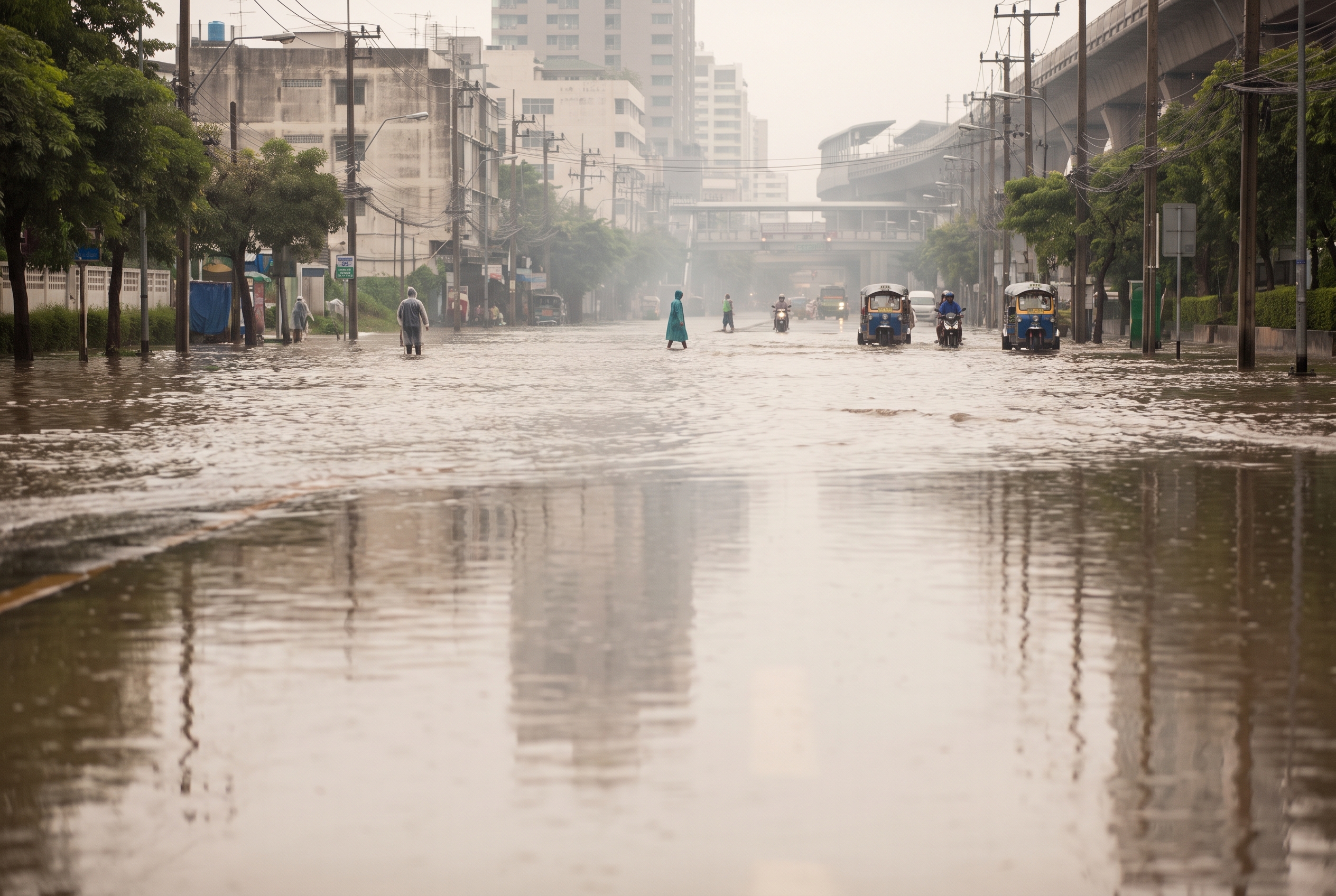
In the final days of September, exceptional monsoon rains hit Thailand, and water also flooded the lower-lying parts of the capital, Bangkok. Roads became impassable, while flight cancellations and a baggage backlog developed at the country’s largest international airport. This article summarises what happened, how much it affects tourists, and what anyone travelling to Thailand in the coming days and weeks — or already there now — should pay attention to.
What happened in Bangkok?
According to a report by Turizmus.com, more than 320 millimetres of rain fell in Bangkok over two to three days, prompting a state of emergency across all 50 districts of the city. The sudden downpour also overloaded canals and the drainage system, which mainly paralysed road traffic.
On 26 September, citing the forecast of the Thai meteorological service, the US embassy issued a warning for the whole country because of heavy rainfall and flash floods.
It is not only the capital that is affected
According to a situation report published on ReliefWeb and based on data from Thailand’s Department of Disaster Prevention and Mitigation (DDPM), flooding spread across 41 provinces between 16 and 28 September. The report says there have been 23 fatalities nationwide, four of them in Bangkok.
The same report mentions around 329,000 affected households in the capital and also says that an alert is in force because of the Chao Phraya River and canals overflowing. This means the situation may still change in the coming days, especially if further rainfall arrives.
Airport: flight cancellations and backed-up baggage
Disruption in air travel became visible gradually. In the first days, the main problem was getting to the airport, but a few days later the situation was already affecting flights and baggage handling as well.
According to a 29 September article by Turizmus.com, Thai Airways cancelled 30 per cent of its flights, while around 5,600 bags piled up at Suvarnabhumi International Airport. Based on the outlet’s report, air force personnel were also deployed to help with baggage handling. It is not yet possible to say with certainty when the timetable and baggage processing will fully return to normal, because that depends to a large extent on how the weather develops.
How can you get around the city now?
According to an analysis by Travel Weekly Asia, fixed-track public transport — the BTS Skytrain and the MRT metro — is operating at full capacity. The publication also reports that the availability of Grab cars and taxis has deteriorated sharply, as huge traffic jams have formed on the roads and some sections are under water.
In practice, this means the rail network is the more predictable option for journeys within the city. For anyone still heading to the airport by car or taxi, Travel Weekly Asia recommends using tolled elevated expressways, as these are less affected by flooding.
Which parts of the city are less affected?
For tourists, an important point is that, according to Travel Weekly Asia, the central tourist and business districts — such as Sukhumvit, Silom and Sathorn — are better protected from flooding because they are at a higher elevation. At the same time, outer districts, including Lat Krabang near the airport, have suffered severe damage, according to the publication’s report.
This does not mean there is no disruption in the city centre: traffic jams and interruptions to services may also be felt there. When choosing accommodation and planning daily activities, it is therefore worth considering how far a given area is from the nearest BTS or MRT stop.
What should you pay attention to before departure?
The US embassy’s warning suggests that anyone who can should postpone non-essential travel. Anyone still setting off should consider the following points:
- Flight status: it is worth checking on the airline’s website or app before departure, and even on the day you leave for the airport, whether the flight is operating according to schedule.
- Extra time: it is worth allowing much more time than usual to reach the airport and, where possible, getting there by rail.
- Baggage: because of the baggage backlog, it may be useful to keep the most important items, medicines and documents in hand luggage.
- Insurance: it is worth finding out under what conditions your own travel insurance or bank card insurance provides cover in the event of flight cancellation, delay or delayed baggage.
- Official information: it is also worth following the travel advice of Hungary’s consular service before setting off.
If you are already in Bangkok
The US embassy’s warning also notes that valuables should be placed on higher levels, and that particular caution is needed near canals. During flooding, walking through inundated streets can also be risky, as there may be hidden obstacles or open manholes under the water.
It is sensible to follow updates from local authorities and your accommodation regularly, and to keep plans flexible. Before onward travel to coastal or rural destinations, it is also worth checking whether the given province is affected, since the floods have reached a significant part of the country.
Overall, the situation in Bangkok is serious, but manageable for tourists if they plan ahead: fixed-track transport is operating, central districts are less affected, but patience and extra time are needed because of disruption at the airport. The situation may change from day to day, so before departure it is always best to rely on the latest official and airline information. The information above is for general guidance only and does not replace specific information from the authorities, the airline or the insurer.
Sources used
- 1.Thailand Flood Situation Report - September 2026reliefweb.intverified
- 2.Weather Alert: Heavy Rain and Flooding Throughout Thailandth.usembassy.govverified
- 3.Járatokat töröl a Thai Airways a bangkoki áradások miattturizmus.comverified
- 4.Bangkok travel industry weathers flood disruptiontravelweekly-asia.comverified
These sources were used during our editorial fact check.