Egészség
Needle-Free Glucose Monitoring Nears Smartwatches
A miniature optical spectrometer could eventually allow wearable devices to track certain metabolic markers without needles. The development is promising, but it remains a prototype: reliable medical use will require further clinical trials and regulatory approval.
2026-10-26 · 5 min read
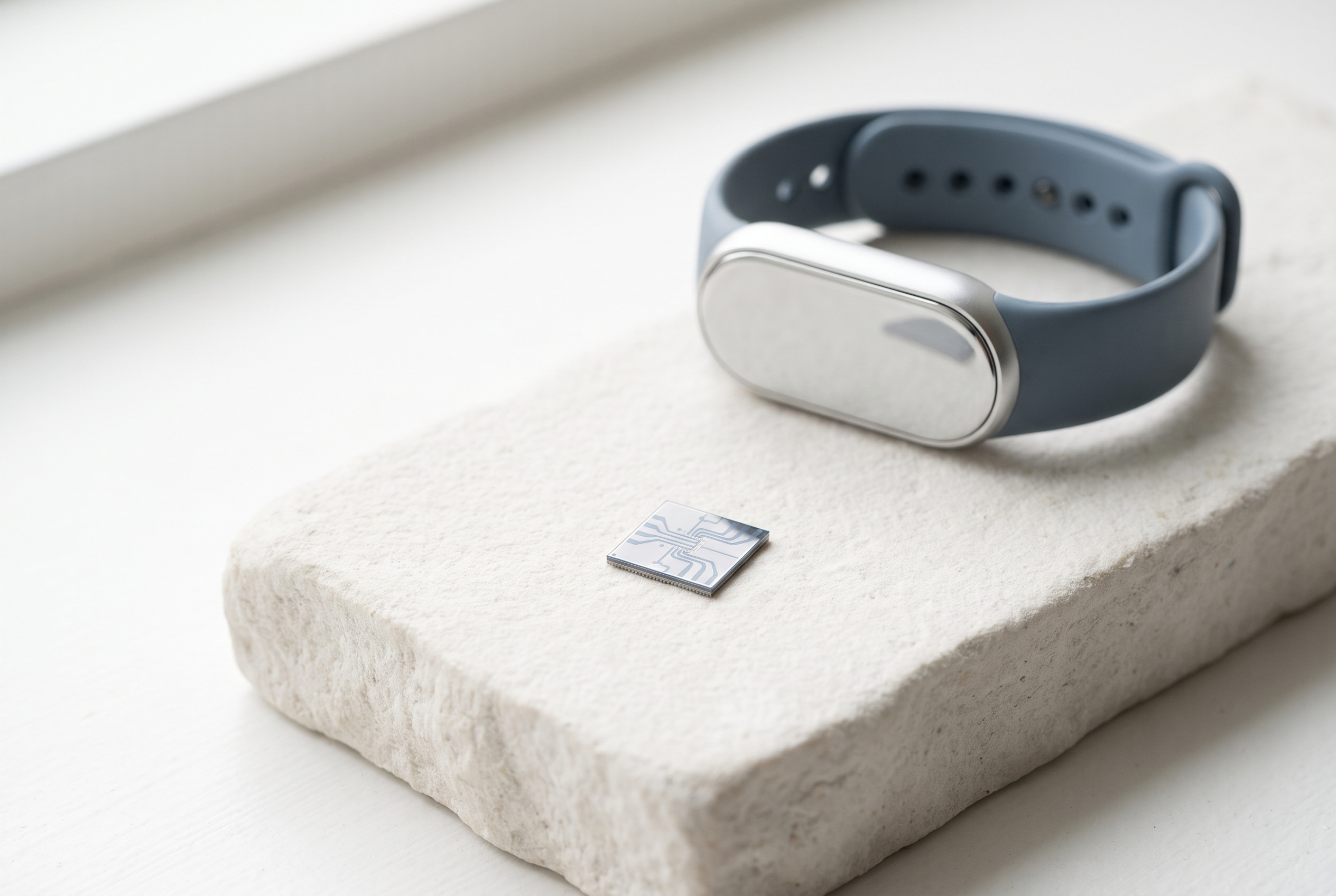
A new miniature optical spectrometer could bring wearable devices closer to needle-free glucose monitoring. Developed by the University of Cambridge and GlitterinTech, it uses near-infrared light to examine the body's chemical characteristics, while being small enough that it could eventually be integrated into smartwatches.
However, the technology is not yet a finished healthcare product. The current results primarily show that the technical approach may be viable; extensive clinical trials are still needed to demonstrate that it remains sufficiently accurate and reliable for different people under everyday conditions.
What makes the miniature spectrometer distinctive?
A spectrometer analyses how a material absorbs or reflects light at different wavelengths. The resulting optical pattern can be used to infer its composition. Conventional high-precision systems are often laboratory instruments, so wearable devices generally have room for much simpler optical sensors.
According to a statement from the University of Cambridge's Department of Engineering, the new so-called convolutional spectrometer is built on a silicon nitride photonics platform. One of the key promises of the approach is that it processes spectral information from light on a small chip, potentially reducing the size and complexity of conventional spectrometers.
The GlitterinTech developer presentation describes button-sized silicon photonics modules complemented by algorithms. This matters because a smartwatch must accommodate more than the sensor alone: power consumption, heat generation and data processing must also fit the constraints of a wearable device.
How could it measure glucose without needles?
The basic idea behind non-invasive measurement is that the device directs light at the skin and then attempts to identify patterns associated with the target substances in the returning signal. However, glucose has a weak optical signal, and other factors – such as tissue composition, hydration, temperature, contact with the skin or movement – can also affect the measurement.
According to GlitterinTech's presentation on wearable devices, the development would use real-time near-infrared spectroscopy to track glucose, lactate and hydration, among other factors. For now, these are development goals rather than approved consumer features.
According to a report by Optics.org, the researchers also conducted continuous glucose-monitoring tests involving a volunteer. This is an important early step, but it does not in itself prove that the method works equally well across a broad population, including different skin types, body types, health conditions and environmental circumstances.
The $10 figure is not the price of a finished smartwatch
Several reports describe the development as a $10 spectrometer. According to the University of Cambridge's Department of Engineering, this estimate refers to the manufacturing cost of the chip, not the consumer price of a complete smartwatch, medical device or finished measurement system.
The final product's cost would also include the light source, optical module, electronics, battery, data-processing system, packaging and software. Clinical trials, quality assurance and regulatory approval procedures could further increase the cost of healthcare use.
Evidence Review's video entitled “$10 Spectrometer Chip Reality Check” assesses the $10 figure as a developer estimate rather than an audited market price. This secondary analysis therefore primarily illustrates the possibility of mass production, not the guaranteed price of the finished device.
A promising technical result is not yet medical evidence
According to a ScienceDaily report, the miniature sensor achieved accuracy comparable to that of benchtop laboratory instruments in some measurements. However, this does not automatically mean that it could measure glucose with clinical accuracy for every user, while moving or during prolonged wear.
Evidence Review's assessment notes that the pool of participants in the longer-term glucose-monitoring trial was extremely limited, and that the models may not necessarily apply to other people without individual calibration. This is a secondary assessment requiring independent confirmation, but it highlights that the technology's generalisability across different users remains an open question.
Accuracy is particularly important in glucose monitoring. An error in an activity or sleep estimate usually causes inconvenience, whereas an incorrect health measurement could lead to a poor decision. There may therefore be a lengthy development and assessment process between a consumer electronics demonstration and an approved medical-device function.
Why could this development still matter?
Miniaturisation could be a significant achievement even if needle-free glucose monitoring does not reach shops in the near future. A small, mass-producible spectrometer could also be useful in other wearable, industrial or laboratory applications where the goal is rapid optical identification of materials.
Alongside glucose, the developers are also investigating the possibility of tracking lactate, hydration and other metabolic characteristics. These indicators do not present identical measurement challenges, so not every function will necessarily become usable at the same time or with the same level of accuracy.
Current smartwatch health features generally process signals from a small number of sensors. A genuinely practical miniature spectrometer could provide richer optical information, potentially enabling new measurements and more accurate trend tracking. The key question is how consistently it can do this outside the laboratory.
When could it appear in a smartwatch?
There is no reliable, publicly announced date for commercial availability. The prototype must first be developed into a stable and reproducible measurement system, after which its performance must be tested with a sufficiently large and diverse group of participants.
For healthcare marketing, the manufacturer must also demonstrate that the device is safe when used as intended and that its measurements meet the requirements of its stated purpose. The route to approval will also depend on whether the device is presented as a general lifestyle-tracking feature or as a tool supporting medical decisions.
For now, the new spectrometer's greatest achievement is not that it can already replace a needle or an under-the-skin sensor, but that it could move a complex optical instrument towards a size and manufacturing process suitable for wearable devices. If later studies confirm its accuracy, smartwatches could provide information about more metabolic characteristics alongside the values they currently track.
The technology does not currently replace approved glucose meters or continuous glucose monitors. Treatment decisions concerning blood glucose levels should not be based on a research prototype or an unapproved smart device. The small chip and low estimated manufacturing cost are promising, but broad clinical evidence, reliable personalisation, regulatory approval and the final consumer price remain unknown; guidance from a healthcare professional should take precedence in health matters.
Sources used
- 1.A new way to see life's hidden chemistry: Mass-manufacturable spectrometer chip for wea…elec.eng.cam.ac.ukverified
- 2.GlitterinTech Optical Module Solutionglitterintech.comverified
- 3.GlitterinTech Intelligent Wearing Applicationsglitterintech.comverified
- 4.Evidence Review: $10 Spectrometer Chip Reality Checkyoutube.comverified
- 5.New class of miniaturized spectrometer suits wearablesoptics.orgverified
- 6.Cambridge scientists created $10 optical spectrometerua.news
- 7.Cambridge scientists have developed a $10 optical spectrometerreddit.com
These sources were used during our editorial fact check.