Űrkutatás & Jövő
Artemis programme: When will humans return to the Moon?
Preparations for Artemis III have reached an important technical milestone: the SLS rocket's two side boosters have been assembled, while work on the core stage is also progressing. Under NASA's current plan, the 2027 flight will still be an Earth-orbit systems test, with a crewed lunar landing targeted for 2028.
2026-10-20 · 5 min read
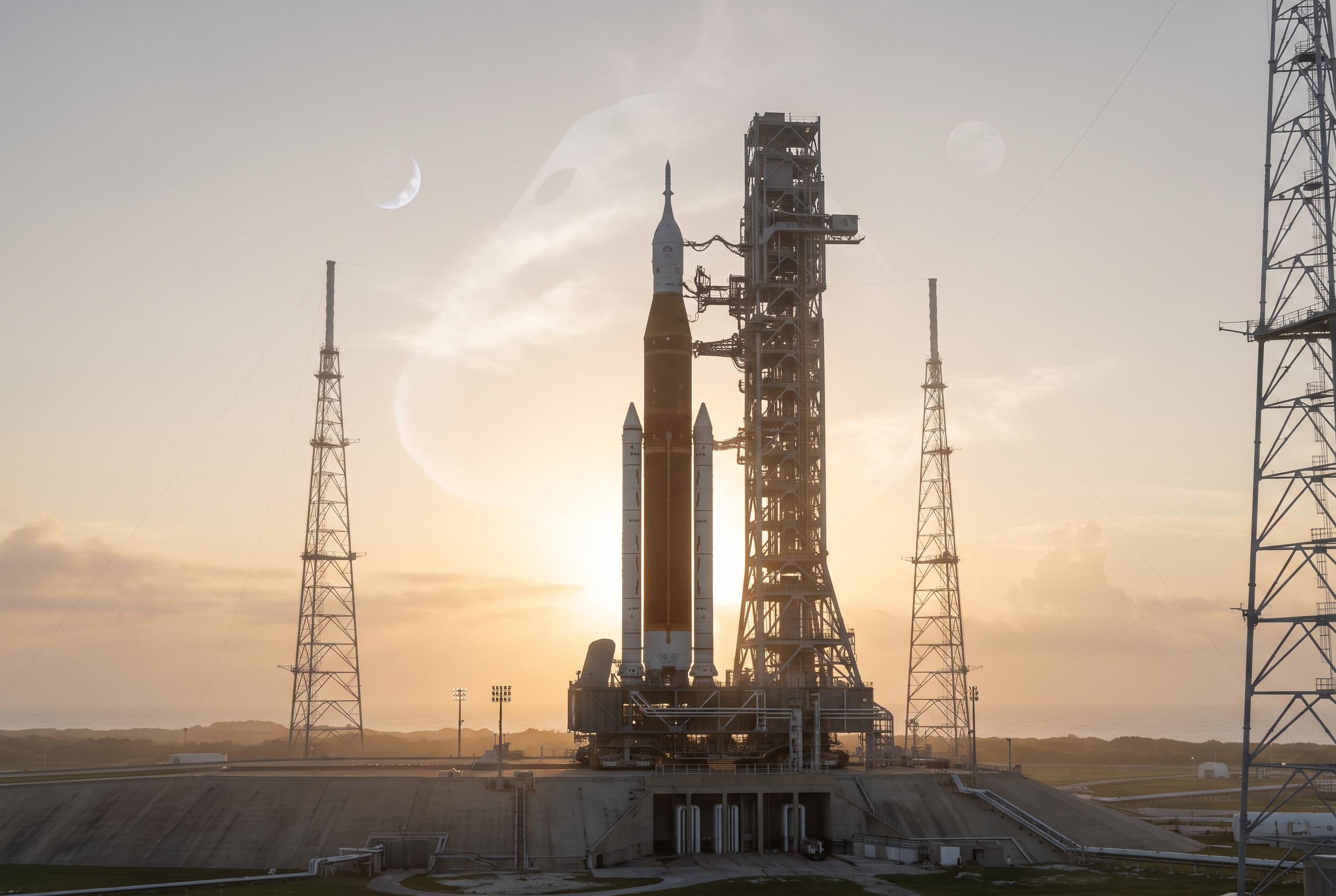
Under NASA's current plan, the next important milestone in the Artemis programme will not be a direct lunar landing, but a complex crewed test flight in Earth orbit. According to NASA's Artemis III mission overview, the flight planned for 2027 would see a crew of four test the operations that will also be needed during subsequent lunar missions.
The revised programme schedule is built around a step-by-step approach. NASA intends to test how the separately developed systems work together before attempting a crewed lunar landing, which is currently targeted for 2028. However, these years are targets rather than guaranteed launch dates.
Artemis III would not land on the Moon in 2027
According to NASA's mission page, Artemis III would be a crewed demonstration flight in low Earth orbit. This represents a significant change from the mission's previously understood role: instead of reaching the lunar surface, the focus would be on system integration and testing key flight operations.
The flight's main objectives would include testing rendezvous and docking with commercial lunar landing systems. NASA's overview names both SpaceX's Starship HLS and Blue Origin's HLS, but it does not establish precisely what role each system would play in the demonstration.
The year 2027 is currently a target date, and the public mission overview does not specify an exact launch day. The timing will depend on the combined readiness of the SLS launch vehicle, the Orion spacecraft, ground infrastructure and the systems provided by commercial partners.
Assembly of the two side boosters is complete
According to NASA's status update of 13 October 2026, assembly of the Space Launch System's two solid-fuel boosters for Artemis III was completed on 30 September. The work was carried out in the Vehicle Assembly Building at Kennedy Space Center in Florida.
The two side boosters are a crucial part of lift-off. According to NASA, they provide more than 75 per cent of the SLS's total launch thrust, giving them a key role in lifting the rocket off the launch pad and accelerating it.
During assembly, the individual segments are stacked and then precisely aligned. Completing this process is tangible progress, but it does not in itself mean that the entire launch vehicle is ready for launch. The system's other components must also be assembled and tested.
The core stage's next test
In the same technical update, NASA said that all four RS–25 engines had been installed on the SLS core stage. The core stage uses liquid propellant and continues to accelerate the rocket after the side boosters separate.
The next important step is preparation for the propellant loading test. Under NASA's plan, the core stage and its attached components will be moved to Launch Pad 39B at Kennedy Space Center in a shortened configuration known as a “short stack”.
The propellant loading test is a ground test, not a launch attempt. It examines how the rocket works with the ground infrastructure used to load propellant. The test provides an opportunity to check processes involving the tanks, pipes, valves and support equipment before the complete flight configuration is assembled.
Why test in Earth orbit before a lunar landing?
Artemis is not a single spacecraft but a combination of several systems. The SLS is responsible for carrying Orion and associated components into space, Orion transports the crew, and a separate landing system is needed to reach the lunar surface. Ground-based control and support infrastructure is also required.
When several separately developed systems work together for the first time, it is not enough to test the performance of each individual component. Communication, navigation, approach, docking and the coordination of successive operations are equally important. An Earth-orbit demonstration can separate these tasks from the additional requirements of a lunar landing.
An analysis by The Planetary Society compares this step-by-step approach with the Apollo 9 mission. According to the analysis, during the Apollo programme the lunar module's independent operation was tested in Earth orbit before the actual lunar landing. However, Artemis differs substantially in its structure, technology and supplier network, so the similarity mainly concerns the logic of phased testing.
What does the new sequence mean for the programme?
The intermediate test mission does not make the Artemis III flight straightforward. A crewed rendezvous and docking is itself a complex operation requiring orbital calculations, navigation, communication and the connecting structures all to function properly.
At the same time, the new sequence separates the tasks more clearly. If NASA first tests how the systems work together in Earth orbit, the subsequent lunar landing mission will not have to perform every critical operation for the first time.
However, this will provide a real scheduling advantage only if development of the launch vehicle, Orion, the landing systems and the ground infrastructure progresses at the required pace. A delay to any important component could also affect the timing of the interconnected missions.
The 23 October briefing may clarify the plans
According to NASA's announcement, the agency will hold a briefing at Kennedy Space Center on 23 October 2026 at 2 p.m. Eastern Time. The announced topics include accelerating the Artemis programme, the status of upcoming missions and the crewed lunar landing targeted for 2028.
The briefing may be important because annual target dates alone do not show which technical and organisational conditions still need to be met. Details about the sequence of tests, the allocation of tasks and the programme's next milestones may provide a clearer picture of whether the schedule is achievable.
Before the announcement, it is not possible to determine whether NASA will provide more specific launch dates or announce further changes. For this reason, the 2027 test flight and the 2028 lunar landing should for now be treated as programme targets.
Several more checkpoints lie on the route to the Moon
In the coming period, progress in the Artemis programme will be marked not by a single spectacular event, but by several interconnected technical steps. The core stage propellant loading test, further assembly of the launch vehicle, Orion integration and preparation of the commercial landing systems will all affect the mission schedule.
Completing assembly of the boosters is an important achievement because one of the SLS's key units has reached the next stage of preparation. For a crewed flight, however, the entire system must demonstrate that it is operational, not just its individual components.
Under NASA's current schedule, a four-person demonstration mission in Earth orbit could prepare for the next step in 2027, followed by an attempted crewed lunar landing in 2028. Whether this timetable can be maintained will depend on the results of the upcoming tests and the coordinated readiness of the various systems.
Sources used
- 1.NASA to Discuss Artemis Acceleration, Status of Upcoming Moon Missionsnasa.govverified
- 2.NASA Completes Artemis III Booster Stacking, Shares Status Updatenasa.govverified
- 3.Artemis III Mission Overviewnasa.govverified
- 4.Artemis Campaign Overviewnasa.govverified
- 5.Artemis Update: NASA Reshapes the Road Back to the Moonplanetary.orgverified
- 6.NASA to Host Media Briefing Outlining Artemis Mission Plans Ahead of 2028 Lunar Landing…spacewatch.global
- 7.NASA Artemis III Booster Stacking & Crew Water Recoveryfriendsofnasa.org
These sources were used during our editorial fact check.